From experience to demand: four frictions holding back an expert brand
How to connect experience, recognizable problems, an understandable offer and a proportionate next step without turning every post into an ad.

A person can accumulate years of experience, publish valuable ideas and be recognized by peers without the market understanding when to turn to them. The gap is not always in professional ability. It often appears in translation: knowledge is not connected with a recognizable situation, a comprehensible offer and a proportionate next step.
Experience is an asset; demand is a market response to a problem it considers relevant. Between the two, various editorial and commercial decisions are involved. If one of them fails, content can build reputation without providing opportunities.
Why doesn't experience automatically become demand?
Because the buyer doesn't directly look at everything a person knows. They look at signals: the problems the expert identifies, the quality of their distinctions, the limits they recognize, the results they can explain and how easy it is to take the next step.
Signal theory helps to explain this gap: when a party cannot directly observe a relevant quality, it uses available signals to infer it (Spence, 1973).
LinkedIn argues that effective thought leadership offers a perspective of its own, teaches something useful and can influence future decisions. Google, from search, recommends content created for a real audience, with demonstrable experience and enough usefulness for the person to move toward their goal. None of these conditions equate to selling. It forces us to ask if the published knowledge can be used by someone outside the expert's head.
Friction 1: experience remains in the language of the expert
It is natural to explain the work from the discipline: strategy, governance, transformation, culture, positioning or artificial intelligence. The problem arises when those categories do not translate into scenes that the market recognizes.
We help with organisational transformation describes a territory. The new process is technically ready, but those responsible continue to make decisions with different rules describes a situation.
Translating does not mean simplifying to deforming, but connecting the concept with decisions, symptoms and observable consequences. Experience preserves depth, but it does not require the reader to know the professional vocabulary beforehand.
A useful check is to review the first lines of the content: do they name a situation or start with a category? If the reader needs to first interpret what the service means for their work, the friction of translation remains present.
Friction 2: the trajectory takes the place of the problem
Credentials, years of experience, certifications, and positions provide confidence, but they do not alone explain what problem a person can address or what criteria they use to do so.
An extensive biography can prove that the expert exists. Content must demonstrate how they think. This happens when they analyze a real tension, compares alternatives or shows why a convenient response in one context can be risky in another.
Order is once again important. An audience usually pays attention first to what they recognize as their own. Then they look for evidence that the speaker has the ability to help. If we always open up with the trajectory, we ask the reader to value the proof before they understand the problem.
Correction is not about hiding credentials; it's about using them as back-up, not as a whole value proposition. The customer problem opens up the conversation; experience helps sustain it.
Anderson, Narus and van Rossum (2006) distinguish proposals focused on the few elements of value that matter to the client from broad lists of benefits.
Friction 3: content and the offer tell different stories
A brand can publish about leadership, productivity, innovation, culture, artificial intelligence and personal development, while its commercial offering presents a different list of services.
Consistency does not require repeating an ad. It requires that editorial pieces and the offer share a territory. If a consultant wants to be considered for diagnosing AI adoption, its content should help recognize suitable processes, risks, necessary data, responsibilities and alternatives. If it publishes only general news about technology, it can achieve visibility without demonstrating the criterion the service holds.
Payne, Frow and Eggert (2017) show that the value proposition has evolved from a one-sided formulation to a strategic resource that integrates the customer perspective and coordinates the work of the organization.
The previous article on content that informs but does not help to decide, available at https://strateria.app/en/blog/contenido-informa-no-ayuda-decidir, The complementary commercial question is: does the decision we help to understand have any legitimate relationship with the offer we can deliver?
If the answer is no, the piece may still be valuable to community or reputation, but it should not be automatically interpreted as demand generation.
Friction 4: the next step does not correspond to the level of confidence
After a good explanation, some brands end with contact us or agenda a meeting. Others offer no continuity. In both cases, the reader must jump from an idea to an action that may be too big or invisible.
A next proportionate step reduces uncertainty without forcing a sale. It can consist of reading a related article, answering a diagnostic question, reviewing a template, creating an account, describing a situation, or requesting a conversation when there is already enough context.
A record indicates something different from a saved one; a consultation with specific restrictions provides more information than a reaction. https://strateria.app/en/blog/visibilidad-demanda-linkedin, No isolated signal proves causation. Its value is in the additional information it allows you to obtain.
The four frictions in a single journey
Experience approaches demand when it goes through four translations: from knowledge to a situation; from experience to a test of criteria; from content to a consistent offer; and from attention to a proportionate next step.
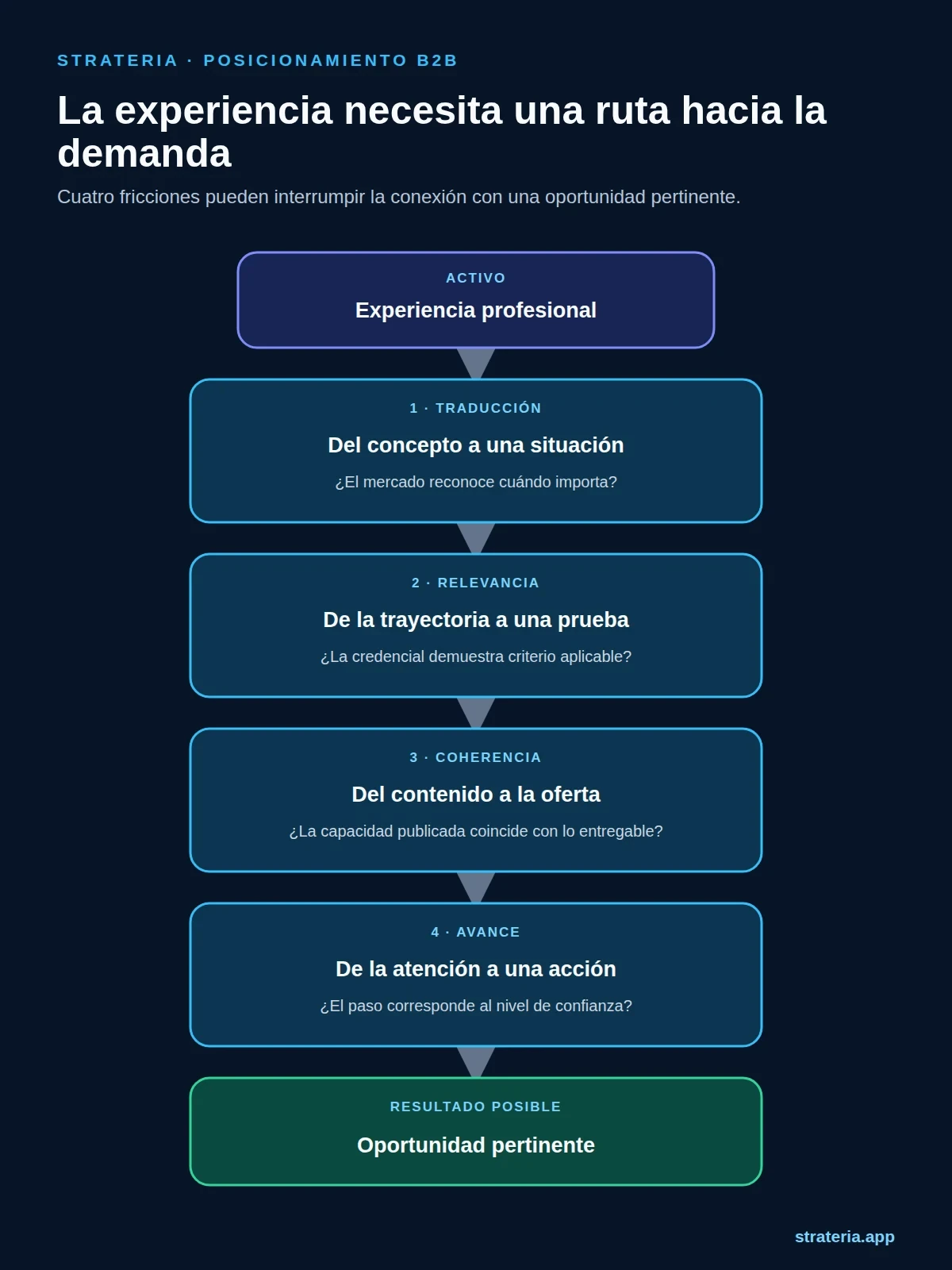
Figure 1. Four frictions between professional experience and B2B demand.
Source: self-made.
Table 1. Rapid diagnosis of the four frictions.
| Friction | Signalling and correction |
|---|---|
| Translated | Note: Content starts with concepts that the audience does not use. Correction: name the situation, decision or consequence that makes the idea relevant. |
| Relevance | Signal: the path takes up more space than the problem. Correction: show what the reader can better understand or decide through that experience. |
| Coherence | Note: published topics are not relevant to the offer. Correction: connect demonstrated ability to a problem that can actually be addressed. |
| Go ahead . | Signal: the call to action is generic, abrupt or nonexistent. Correction: propose the most useful step for that level of confidence and intention. |
The table serves to formulate hypotheses, not to automatically diagnose a strategy. A content may not produce queries due to insufficient distribution, lack of prioritization, long purchase cycle or lack of fit, even when the message is clear.
How to reduce friction without turning content into advertising
A balanced editorial sequence can perform different functions:
1. Discovery: making visible a situation that the audience had not named. Understanding: explaining relevant causes, consequences and relationships. 3. Consideration: comparing alternatives, criteria, risks and limits. 4. Demonstration: showing how a method, tool or intervention works. 5. Advance: offer action proportionate to the context available.
Not all pieces need to go through the five stages. What's important is knowing which ones meet and how they relate to each other. A short post can open up a question; an article can deepen it; a tool can help apply it; and a conversation can determine whether there is a fit.
This system also prevents the expert from trying to say everything in one piece. Experience becomes more understandable when it's distributed in small, connected decisions, not when it's summed up in an endless list of topics or services.
A connection test before publishing
Before we approve a piece, we can complete this chain in a single sentence:
We help the [audience] facing [situation] to understand or decide [concrete tension] through [criteria or demonstrated ability], and we propose [next proportionate step].
If the phrase requires vague terms such as 'grow', 'transform' or 'reach success', it is best to specify the situation. If the criterion cannot be observed in the content, there is no demonstration. If the next step requires buying before understanding, there is friction of progress.
The phrase should not be published literally. It is an internal control tool to verify that audience, problem, criterion and action form a coherent chain.
What role does Strateria play?
Strateria helps to organize that chain before publishing: audience, situation, thesis, evidence, relationship with the offer and call to action. It also allows to sustain an editorial sequence in which each piece fulfils a function and connects to the previous ones.
The tool does not turn experience into demand by itself, nor does it replace interviews, business conversations, or market validation. Its contribution is to reduce operational friction and maintain a reviewable system to learn which messages arrive, which questions appear, and which routes produce the most useful signals.
Conclusion: Demand starts when experience becomes usable
The market cannot value all the experience that remains implicit. It needs to recognize situations, evaluate criteria and understand how to move forward.
Connection improves when we translate knowledge into the language of a decision, use the trajectory as evidence, align content and the offer, and propose a next step proportionately. That trajectory doesn't guarantee customers. It does make the experience more understandable, valuable, and useful for those who might actually need it.
From experience to a useful position
| Become a member of Strateria |
|---|
| If your publications still don't clearly connect audience, situation, criterion and next step, Strateria membership helps you sort that chain and maintain a consistent editorial presence without promising that the content will create demand on its own. |
| Register with one click: https://strateria.app/register · Free access · No card. |
References
Anderson, J. C., Narus, J. A., y van Rossum, W. (2006). Customer value propositions in business markets. Harvard Business Review. https://hbr.org/2006/03/customer-value-propositions-in-business-markets
Google Search Central. (2026). Creating helpful, reliable, people-first content. https://developers.google.com/search/docs/fundamentals/creating-helpful-content
LinkedIn. (2026). What is thought leadership? https://business.linkedin.com/advertise/resources/marketing-terms/thought-leadership
Payne, A., Frow, P., y Eggert, A. (2017). The customer value proposition: evolution, development, and application in marketing. Journal of the Academy of Marketing Science, 45, 467–489. https://doi.org/10.1007/s11747-017-0523-z
Spence, M. (1973). Job market signaling. The Quarterly Journal of Economics, 87(3), 355–374. https://doi.org/10.2307/1882010