Visibility is not demand: how to turn LinkedIn content into B2B opportunities
A practical framework for distinguishing reach, authority, demand and opportunity, and recognizing what must happen for B2B content to generate genuine interest.

Getting impressions, reactions, or followers means that a content has been distributed and viewed. It doesn't prove that the market understands what problem we solve, considers that situation a priority, or is willing to take the next step. Visibility opens a door; demand appears when a relevant audience recognizes a problem, attributes value to solving it, and shows a sign of intent.
This difference changes strategy. When you confuse reach with demand, the usual response is to publish more. However, increasing the frequency can amplify the same mismatch: more people see the message, but still don't understand who it is for, what situation helps to solve or why it would be appropriate to act.
Holliman and Rowley (2014), in studying B2B digital content marketing practices, stress the importance of producing valuable, relevant and timely content from the customer's perspective.
What's the difference between visibility and demand on LinkedIn?
Visibility describes exposure: content appears before an audience. Authority arises when that audience associates a person or organization with criteria and ability. Demand implies interest in solving a situation. An opportunity adds context, fit and a real possibility of advancement. They are related results, but not equivalent.
They should be treated as a learning sequence:
Table 1. Four results that are often confused when evaluating B2B content.
| Stage | Question and correct reading |
|---|---|
| 1 | Impressions, reach and visits describe exposure, but still show no commercial interest. |
| 2 | Authority. Did the content provide judgment and trust? Saved, shared, returned, and referenced may suggest usefulness, but they don't prove a current need. |
| 3 | Question. Does anyone recognize the problem and want to explore it? Relevant clicks, contextual responses, and visits to solutions get closer to the intent, but they don't confirm fit or purchasing power. |
| 4 | Opportunity. Is there a concrete situation and possibility of moving forward? A record, a consultation, an accepted meeting or a diagnosis provide context, but they do not amount to a closed sale or prove that a single publication caused it. |
The table does not propose a rigid funnel in which all people must go through the stages in the same order. It serves to avoid leaps of interpretation. A reaction can contribute to authority; a visit to a solution page can approach the demand; a conversation with context can reveal an opportunity. In each case changes both the question and the necessary evidence.
A person can read several articles for months before needing a solution. The framework known as 955, published by the B2B Institute of LinkedIn, posits precisely that a large portion of potential buyers are not ready to buy at a given time. It is a planning reference, not a universal law. Its usefulness consists in remembering that content also builds memory and understanding for future decisions.
Why does a post with many impressions fail to generate customers?
Because a print only credits distribution. Between viewing content and seeking help, there are other conditions: audience relevance, clarity of the problem, credibility of the response, priority of the situation and ease of the next step. If one of these fails, there can be unclaimed attention.
1. The public is broad but not relevant
A general topic can produce many reactions because it's familiar, emotional, or entertaining. That doesn't mean it reaches those who live the problem that the offer can solve. For a B2B firm, a hundred readers with related roles, contexts, and needs can contribute more learning than thousands of scattered impressions.
The useful question is not only, ‘How many people saw it?’ but also, ‘Who saw it, and what situation did they recognize?’ If the comments come from colleagues who celebrate the idea, but never show up buyers, users or influencers from the target market, it is worth revising the approach.
2. The idea brings value, but it does not name a recognizable problem
A content can be correct and yet remain too abstract. The strategy is important generates agreement; the teams publish frequently, but marketing and sales describe different offersit allows you to recognize a situation, discuss its causes and assess the cost of not correcting it.
Google recommends creating useful content for a real audience and with a clear main purpose. That criterion is also commercially relevant: the more interchangeable a post is, the less information it offers about the specific experience of the person signing it.
3. There is credibility, but the offer is not understood
Authority answers, ‘Why should I listen?’ The offer answers, ‘Why should I take the next step?’ A person can admire a reflection without knowing what kind of help exists, for whom it is designed or what result it is trying to produce.
It's not about inserting a sale into every paragraph. It's about keeping consistency between the problems analyzed, the capabilities demonstrated and the solutions available. https://strateria.app/en/blog/entender-que-quiere-mercado-linkedin, explains how to contrast those connections with evidence rather than assume them.
4. Call to action demands too much or leads nowhere
Contact us can be a disproportionate request for someone who barely discovers an idea.
Commitment should grow gradually: read a related piece, review a diagnosis, create an account, answer a specific question or describe a situation. The next step works when it extends the value of the content and reduces uncertainty; fails when it tries to close a sale before proving relevance.
A B2B example: plenty of attention, insufficient learning
Let's imagine a software company publishing a broad reflection on productivity. The piece circulates, receives compliments and attracts professionals from very different sectors. The team concludes that there is demand and adds a direct call to request a demonstration. No relevant requests arrive.
The problem isn't necessarily the quality of the publication. You may have fulfilled a function of visibility and even authority, but you haven't yet connected that attention to a situation that the market can recognize. To learn more, the following piece could describe a specific episode: a sales team that loses continuity because each person records information in a different place. Then you could compare alternatives, explain to which organizations the problem is a priority, and offer a brief diagnosis instead of asking for an immediate purchase.
If then questions arise about integration, accountability, timing or adoption, the signal changes quality. There is no longer just approval of an idea; context and restrictions begin to emerge. Still, it is not appropriate to declare that the content generated a customer. You should check who asks, what problem is trying to solve, what other interactions influenced and whether a next step was agreed. The example is hypothetical, but shows why a useful strategy designs content to reduce uncertainty progressively, not to attribute a sale to the last post seen.
What makes attention a B2B business opportunity?
Attention can become an opportunity when four conditions match: a relevant situation, an audience with a real relationship to the problem, a credible response, and a proportionate next step.
Relevance: from a specific situation
Relevance is enhanced when the reader can identify a work scene, a tension or a decision. It is useful to explain why it happens, what consequences it produces and under what conditions it changes.
Fit: talking to someone who lives, influences or decides on the problem
In B2B sales, there is rarely a single interlocutor. There can be users, functional managers, buyers, leaders, and support areas. A content needs to know which one helps and which question answers. Trying to include them all in each piece tends to dilute the message.
Reliability: showing judgement, evidence and limits
Confidence does not depend on categorical sounding. It often grows when interpretation evidence is distinguished, conditions are acknowledged and caveats are explained. Cases, data, sources, contextualized experience and decision frameworks allow assessing the quality of a proposal without resorting to grand promises.
Continuity: offering a coherent next step
A good call to action does not interrupt the article; it completes its logic. If the piece helps diagnose an editorial system, the next step may be to organize ideas, audiences, and goals.
Which metrics indicate demand, and which indicate only visibility?
Impressions and reach describe distribution. Saved, shared, and recurring readers can suggest utility or authority. Relevant clicks, contextual responses, and visits to solution pages are closer to demand. Records and queries with a specific situation allow you to evaluate opportunities. No isolated metric proves causality.
The rate of interaction should also not be automatically interpreted as business intent. Google Analytics defines session participation by active time, views, or events; it is a measure of behavior, not necessity or willingness to buy. Similarly, a reaction on LinkedIn can express agreement, courtesy, identity, or intellectual interest.
It is worth noting the full chain:
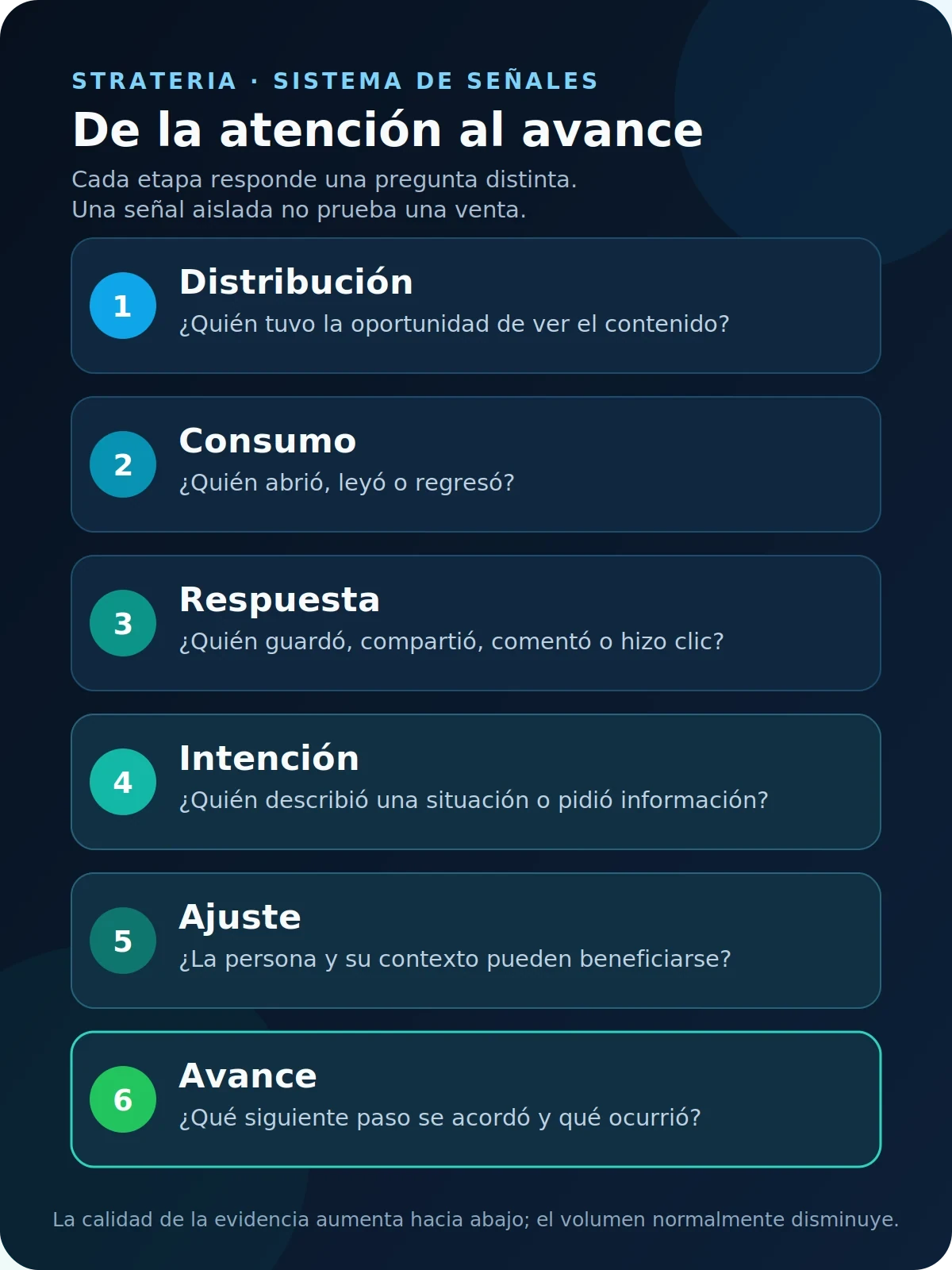
Figure 1. From attention to progress: six questions to read the quality of the signals.
Source: self-made.
The figure orders the signals by proximity to a particular business situation. As we move forward, the volume usually decreases and the information available increases. Many people may have the opportunity to see a publication; less read it; some respond; and only one part describes a situation, fits the solution and agrees on an action. This does not make the chain a universal conversion rate. Its function is to show which question remains open at each stage.
This architecture avoids two mistakes. The first is to disregard visibility, which is still necessary for discovery to exist. The second is to attribute a full opportunity to the last post seen, ignoring previous conversations, recommendations and content.
Table 2. Diagnostic matrix for interpreting combinations of signals.
| Case in point | Interpretation, verification and decision-making |
|---|---|
| 1 | High reach and low consumption. The topic or start can attract without sustaining the promise for that audience. It is worth checking reading time, clicks, returns and consistency between title and development before increasing frequency. |
| 2 | High consumption and low intent. Content can be useful as long as the problem or offer remains abstract. Questions, pages visited and clarity of the next step must be examined; then, more specific situations are named and a low-commitment action is tested. |
| 3 | High intention and low fit. The message could arouse interest outside the segment that can actually benefit. It is worth contrasting position, sector, context, restrictions and relationship to the problem, and then fine-tuning the distribution, examples and limits of the proposal. |
| 4 | High fit and low progress. There may be relevance along with friction, risk or lack of priority. It is necessary to review objections, participants, timing and proposed action to reduce uncertainty and offer a proportionate step. |
| 5 | Moderate reach and useful conversation. The piece may be reaching a small but valuable audience. Before discarding it by volume, it is worth noting recurrence, quality of context and subsequent continuity, and deepening the topic if these signals converge. |
These rows are diagnostic hypotheses, not automatic conclusions. The same pattern can have different causes: a drop in consumption could be due to the message, format, distribution or incomplete measurement.
How do you know if the content attracts the right audience?
It is useful to compare the intended audience with the observed signals. The positions, sectors and situations described in comments or queries are useful; the pages visited after the article; the questions that appear; and the quality of the shared context. If the reach increases but none of these signals improve, there may be an fit problem.
Before publishing more, answer five questions:
- Who is this piece written for and who is deliberately left out?
- What particular situation can this audience recognize?
- What new criteria will help you interpret or decide better?
- What evidence, experience or limit makes the thesis defensible?
- What's the next most useful and proportionate step?
If there's no clear answer, increasing frequency doesn't solve the vacuum.
How do you generate demand on LinkedIn without selling every single post?
Generating demand doesn't require turning every content into an ad. It requires building a consistent association between an audience, certain problems, and a useful way to address them. Some pieces help recognize the problem; others explain alternatives, show evidence, answer objections, or facilitate a next step.
A balanced strategy combines:
- discovery contents that name unseen situations;
- content of consideration comparing criteria, options and risks;
- demonstrations showing how a real solution works;
- cases and evidence with sufficient context not to exaggerate results;
- calls to action adapted to the reader's level of intention.
Consistency is still important, but as a capacity to sustain a learning system, publishing every day is of no value if you don't record what topics attract what people, what questions arise and what paths lead to relevant conversations.
What role does Strateria play in this process?
Strateria helps to organize the work that occurs before and after publication: turn ideas into readable content, maintain a consistent editorial presence and connect each piece with a goal.
The difference is important. Automating a confused message allows it to be repeated faster. A useful system, on the other hand, preserves human criteria to define audience, thesis, evidence and next step, and uses technology to reduce operational friction.
Conclusion: Stop counting publications and start reading the market
Visibility is valuable, but it only answers the first question: did someone have the opportunity to see us? Authority adds confidence; demand adds interest in solving a situation; and opportunity demands context, fit and the ability to move forward.
When these stages are measured separately, the content stops being evaluated as a competition of impressions. It becomes a system for understanding the market, demonstrating judgment, and facilitating relevant conversations. The decision is no longer just about publishing more. It's about improving the connection between what we know, the problem an audience recognizes, and the next step that can really help them.
From visibility to learning
| Become a member of Strateria |
|---|
| If you publish consistently, but still struggle to connect ideas with goals and opportunities, Strateria membership helps you organize a reviewable, consistent and easy-to-improve editorial flow without confusing attention with demand. |
| Register with one click: https://strateria.app/register · Free access · No card. |
References
Google Analytics Help. (2026). Engagement rate and bounce rate. https://support.google.com/analytics/answer/12195621
Google Search Central. (2026). Creating helpful, reliable, people-first content. https://developers.google.com/search/docs/fundamentals/creating-helpful-content
Holliman, G., y Rowley, J. (2014). Business to business digital content marketing: marketers’ perceptions of best practice. Journal of Research in Interactive Marketing, 8(4), 269–293. https://doi.org/10.1108/JRIM-02-2014-0013
LinkedIn. (2026). Demand generation marketing explained. https://business.linkedin.com/marketing-solutions/success/marketing-terms/demand-generation
LinkedIn B2B Institute. (2026). The 95–5 Rule. https://business.linkedin.com/marketing-solutions/b2b-institute/b2b-research/trends/95-5-rule