Your content informs, but does not help people decide: three symptoms of an expert brand
A practical test for recognizing when a post demonstrates knowledge but neither reduces uncertainty nor guides the reader's decision.
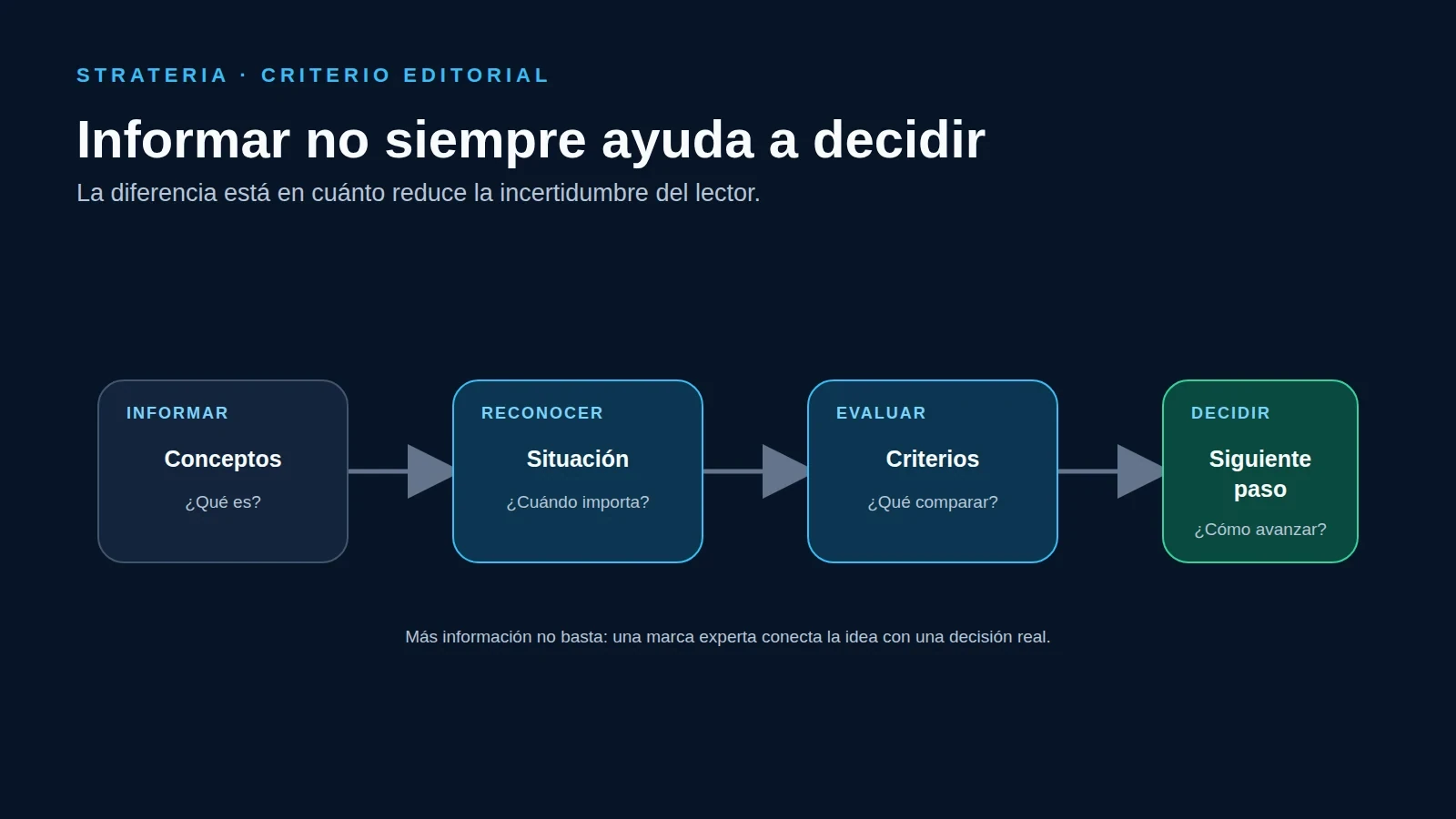
Your content may be well written, correct, and experience-proven, but it still leaves the reader exactly where it was. This happens when the publication adds information without reducing the uncertainty surrounding a decision: it explains a topic, but it doesn't clarify what situation matters, what alternatives exist, or under what conditions it is appropriate to act.
An expert brand doesn't need to turn every post into a sale, it does need to help its audience think better, and the difference comes when the reader ends up with a criterion they didn't have before: they can recognize a problem, rule out an option, ask a more precise question, or choose a next proportionate step.
How do you know if the content is informative, but it doesn't help you decide?
There are three common symptoms: text explains a concept without putting it into an actual decision; it offers recommendations without conditions or caveats; and leaves the reader with the task of interpreting and applying all the information to their own case.
LinkedIn describes thought leadership as content capable of initiating conversations and guiding future decisions through its own perspective. It also warns that the abundance of low-quality material reduces the value perceived by B2B decision makers. Google, from another logic, poses an equally demanding question: After reading, did the person learn enough to move forward toward their goal? Both references point to the same difference: informing is necessary; helping to use information brings greater value.
The research on buyer behaviour distinguishes between not knowing enough and not knowing which alternative to choose; both forms of uncertainty influence the search for information (Urbany, Dickson and Wilkie, 1989).
Symptom 1: the content explains the subject, but not the situation
A publication can define leadership, artificial intelligence, positioning, or productivity accurately, but if it doesn't show when that concept changes a decision, the reader only receives general knowledge.
Let's compare two hypothetical openings:
- AI governance establishes principles, roles and controls for using technology responsibly
- Your team already uses AI to prepare proposals, but no one knows what data can be uploaded, who checks the result, or what happens if the tool goes wrong
The first sentence informs. The second allows you to recognize a situation and opens up questions that an organization needs to solve. They are not exclusive alternatives: the definition can be useful after the problem is visible. The order matters because an audience will hardly value an answer if they still don't recognize the decision they have in front of them.
The test is simple: can the reader identify a specific work scene, tension or consequence? If the text only brings together broad definitions and benefits, the brand is describing a topic; it is not yet demonstrating how it interprets it.
Symptom 2: the recommendations do not show conditions or caveats
Publishing consistently, automating your processes or listening to your team can be reasonable advice.
The criterion becomes visible when the content distinguishes:
- for whom a practice can be useful and for whom not;
- what evidence supports the recommendation;
- what risk or cost it entails;
- what condition must be met before applying it;
- what an alternative it's worth considering.
Explaining limits doesn't weaken authority. It makes it evaluable. A brand that recognizes that automating a confusing process can amplify the error proves more of a criterion than a brand that promises efficiency without examining data, accountability and exceptions.
In B2B markets, Anderson, Narus and van Rossum (2006) warn that a solid proposal is not to list all possible benefits, but to focus on the elements of value that matter to the customer and to support them credibly.
This also protects business integrity. Content should not make urgency or present its own product as an automatic response. It can show a defensible route and, at the same time, recognize when a conversation, a diagnosis or even another solution is most appropriate.
Symptom 3: the reader must do all the interpretive work alone
The third symptom is when a publication delivers ideas but does not help to apply them. The reader has to figure out for himself what question to ask, what signal to observe, or what first step to take.
A decision-oriented content doesn't need to solve a whole project. It's enough to offer a proportional tool: a matrix, a comparison, a sequence of questions or an exclusion criterion.
Table 1. Three symptoms and the corresponding editorial correction.
| Symptoms of this condition | Diagnosis and correction |
|---|---|
| Subject without situation | It gets definitions, but it doesn't recognize when they matter. |
| Council without conditions | You get a recommendation, but you can't evaluate whether it's right for your case. |
| Information not translated | You get ideas, but you don't know what to observe or do next. |
The table does not make each publication into a comprehensive guide. Some pieces fulfill a discovery function and only need to make a problem visible. Others compare options or answer objections. The important thing is that the function is defined and that the reader does not receive a promise other than what the content can fulfill.
Tversky and Kahneman (1981) showed that different formulations of the same problem can alter preferences, so it is advisable to state conditions, alternatives and consequences carefully: guiding does not mean pushing the reader towards the option that favors the brand.
From the volume of information to the decision criterion
One way to review content is to look at the path it proposes. The weaker text accumulates concepts and expects the audience to build relevance on its own. The most useful text starts from a situation, identifies the decision, compares criteria and offers a step that allows you to learn more.
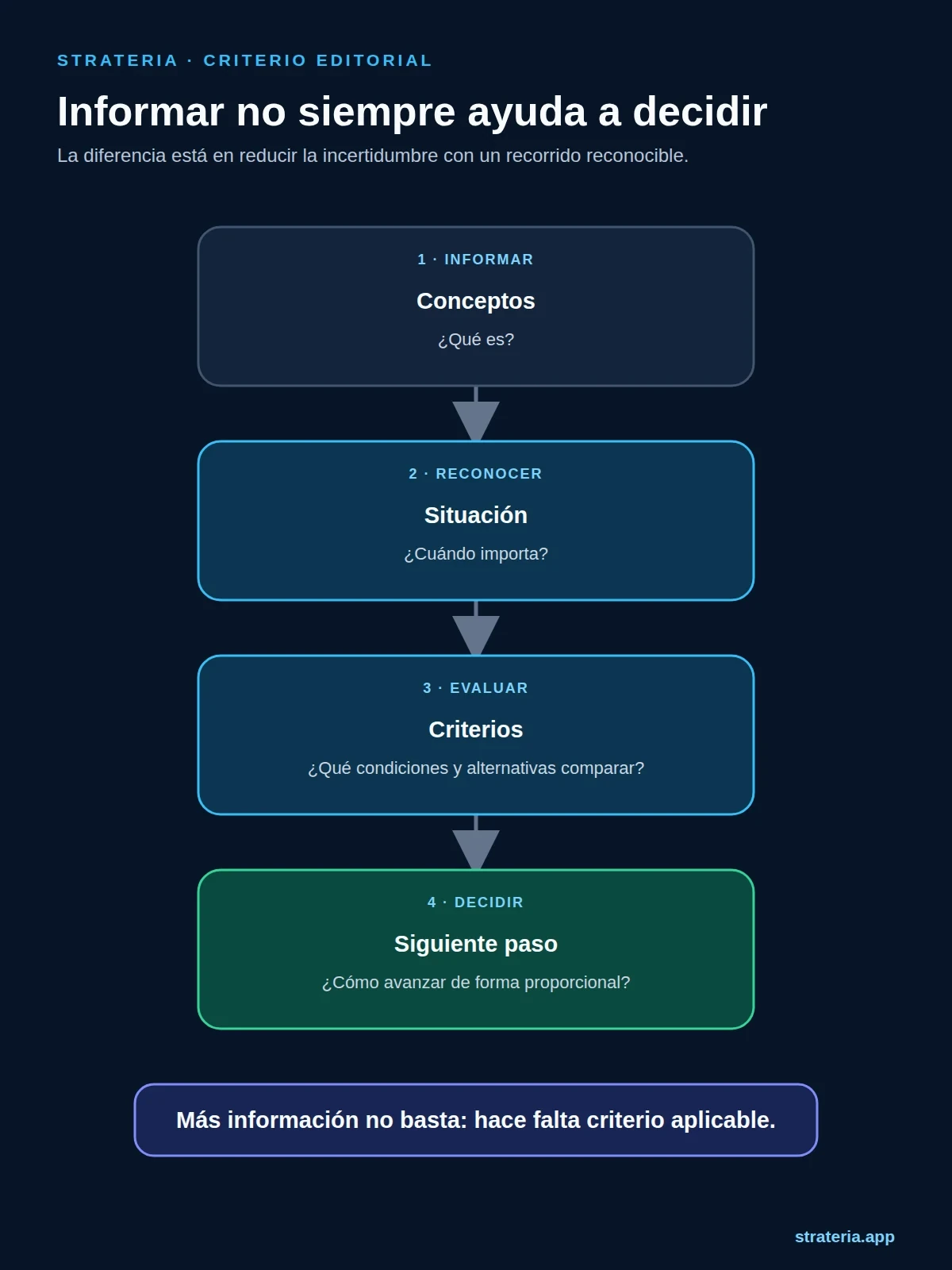
Figure 1. Reporting versus helping to decide: the difference is in reducing uncertainty.
Source: self-made.
This tour also does not prove that a publication will cause a purchase. Between reading and hiring, there are priorities, budget, trust, participants and alternatives. Content input is more modest and more verifiable: helping a relevant audience better understand the problem and more clearly assess how to move forward.
One example: from general advice to applicable criteria
Imagine a consultancy publishing: Companies need to adopt artificial intelligence to stay ahead The phrase may be eye-catching, but it doesn't help decide where to start or what risks to avoid.
The same experience could be expressed as follows:
Before automation, identify a repetitive process with relatively stable rules, available data and a person responsible for reviewing exceptions. If the process affects hiring, labour evaluation or third party rights, the control threshold should be higher and may not be the best pilot
The second version does not provide a complete implementation. It does offer selection criteria, an operating condition and a limit. It allows a manager to discard a bad starting point or formulate a more useful question. The authority ceases to depend on stating that AI is important and begins to show itself in the quality of the distinction.
The five-question test before publishing
Before approving a piece, it is appropriate to answer:
1. What specific situation will the audience recognize? 2. What decision, tension, or question helps you to interpret? 3. What new criterion does the reader gain? 4. What limitation, condition or alternative prevents the recommendation from being exaggerated? 5. What is the next most useful and proportionate step?
If the answers are vague, adding more words does not usually solve the problem. It is worth going back to the experience that originated the idea: a conversation with a client, an objection, a difficult decision, a recurring mistake or a comparison between alternatives.
What role does Strateria play?
Strateria helps organize the editorial process so that audience, situation, thesis, evidence and call to action can be reviewed before publication. The tool does not replace experience or guarantee commercial opportunities. Its function is to reduce friction, preserve traceability and facilitate each piece to have a recognizable purpose.
Automation is useful after defining those criteria. Without them, it only allows you to distribute faster a message that the market can't yet use. With them, you can sustain a cadence without losing editorial control.
Conclusion: an expert brand demonstrates how it decides
Valuable content is not only measured by the amount of information it delivers, but also by the uncertainty it helps reduce. An expert brand becomes more credible when it connects concepts to situations, shows conditions, and offers criteria that the audience can apply.
Not all publications should close a sale or solve a complete problem. But each should fulfill a clear function: to help recognize, compare, decide, or advance. When that function disappears, the content can still sound smart while leaving intact the most important question of the reader: What does this mean for my situation?
From information to judgment
| Become a member of Strateria |
|---|
| If your publications explain a topic well, but still leave the reader without a clear next step, Strateria membership helps you review audience, situation, thesis, evidence, and action before publishing. |
| Register with one click: https://strateria.app/register · Free access · No card. |
References
Anderson, J. C., Narus, J. A., y van Rossum, W. (2006). Customer value propositions in business markets. Harvard Business Review. https://hbr.org/2006/03/customer-value-propositions-in-business-markets
Google Search Central. (2026). Creating helpful, reliable, people-first content. https://developers.google.com/search/docs/fundamentals/creating-helpful-content
LinkedIn. (2026). What is thought leadership? https://business.linkedin.com/advertise/resources/marketing-terms/thought-leadership
Tversky, A., y Kahneman, D. (1981). The framing of decisions and the psychology of choice. Science, 211(4481), 453–458. https://doi.org/10.1126/science.7455683
Urbany, J. E., Dickson, P. R., y Wilkie, W. L. (1989). Buyer uncertainty and information search. Journal of Consumer Research, 16(2), 208–215. https://doi.org/10.1086/209209