Publishing consistently does not fix confusing positioning
A practical audience-problem-promise-proof system that helps editorial consistency reinforce clear positioning instead of repeating disconnected messages.

Publishing consistently seems like a sensible answer when an expert brand wants to gain visibility. A calendar is opened, topics are assigned, and a frequency is set. For a few weeks, tips, stories, opinions, and comments about the present appear. Each piece can be well written. However, looking at the whole, there is a difficult question to answer: why should a particular person remember this expert when faced with a particular problem?
Frequency doesn't solve that question, it just creates more opportunities for the market to find a clear answer or a collection of unrelated messages.
A useful positioning is not an ingenious phrase for biography or a list of services. It's a system of decisions that connects an audience, a problem, a prudent promise, and sufficient evidence. When those decisions exist, the content can explore them from different angles without losing consistency. When they are missing, each publication starts from scratch.
This article proposes a minimum system before making publication routine. It does not guarantee demand, customers or authority. Its purpose is more modest and necessary: to make the position understandable, comparable and reviewable.
Consistency amplifies what is already decided
An editorial cadence helps sustain presence, learn and accumulate an archive of ideas, but it doesn't decide for itself who the brand is aimed at, what problem it wants to interpret, what difference it can make, or what evidence supports its promise.
Google recommends creating content primarily for people and asks, among other criteria, whether the site has an existing or planned audience that would find the content useful. It also warns against producing many pieces on various topics in the hope that some will work in search engines.
LinkedIn, for its part, separates in page analytics metrics such as impressions, members reached, clicks and interaction rate. The platform can show what happened with distribution and some actions. It cannot decide what position the organization wanted to build or interpret by itself if a comment reflects recognition of the criterion, interest in a problem or business intention.
That's why it's important to understand constancy as an operational multiplier, not as a complete strategy. Repeat signals. If the signals are consistent, it increases the likelihood that an audience will recognize a pattern. If they change from audience, problem, and promise in each piece, they also repeat that dispersion.
Keller (1993) explains brand value from associations and responses that knowledge of a brand is active in memory. Applied carefully transferred to professional content, this helps to understand why repetition only builds a position when signals allow consistent and differentiated associations to form.
Decision 1: to whom should this position be relevant?
Leaders, companies or professionals are usually too broad categories to guide a publication. Within the same category there are very different problems, moments and buying criteria.
Defining an audience does not mean excluding everyone else forever; it means choosing who should first recognize the situation described and who can use the criterion presented.
A useful editorial definition combines at least three elements:
1. The role or type of organisation. 2. The situation they are experiencing. 3. The decision you need to make.
For example: societies of service firms that rely on the founder's reputation and need to distribute expert voice without making it generic. This formulation guides better than businesses B2B. It allows you to select consistent scenes, objections, examples and calls to action.
Before you approve a topic, ask: what should the reader say this describes a decision I'm facing? If the response changes in each post without deliberate architecture, the system still doesn't have a priority audience; it has a total of potential visitors.
Decision 2: What problem helps to interpret better?
An expert brand can talk about many topics it knows about. That doesn't mean that everyone contributes to the same position. The editorial problem must connect the expert's ability with a difficulty that the audience recognizes and wants to understand.
Here it's important to distinguish symptom and problem. We need to publish more it can be a symptom. Below it may be a difficult offer to explain, a poorly defined audience, messages incompatible between leadership and sales or lack of evidence. If the content always responds to the symptom, it will accumulate tactics. If it helps diagnose the structure of the problem, it will demonstrate judgment.
The U.S. Federal Trade Commission argues that advertising should be truthful, not misleading, and backed up when appropriate. Although an educational article is not identical to an advertisement, the rule provides useful discipline for commercial communication: not presenting a possibility as certainty, not fabricating urgency, and not promising results that the evidence does not allow to sustain.
A prudent wording might be: we help expert teams reduce the inconsistency between what they know, what they publish and what they can offer. Name a tension without declaring that every reader suffers from it or that a tool will automatically eliminate it.
Decision 3: What promise can be upheld without exaggeration?
The editorial promise is a response to what change of understanding, decision or ability the reader can obtain. It doesn't always have to be a commercial transformation.
It's okay to write the promise on two levels.
The first is the promise of the piece: when you finish, you can check whether audience, problem, promise and test remain aligned. It must be fulfilled within the article.
The second is the promise of the position: this brand offers criteria and a supervised system for ordering professional content.
The simplest test is to finish the sentence: after reading this, the person will be able to.... If the end demands an outcome that depends on budget, market, execution, time or decisions of third parties, the promise needs to be reduced. Getting customers does not depend only on reading or publishing. Distinguishing signals of attention, authority, demand and opportunity can indeed be a verifiable editorial outcome.
A prudent promise doesn't make the content weak, it makes it credible and allows experience to appear within the boundaries: what is useful, in what context and what can't be concluded yet.
Decision 4: What evidence accompanies the criterion?
The experience stated needs traces that the reader can evaluate. The test is not just a case of success or a figure. It can be a primary source, an official definition, an observable procedure, a demonstration, a transparent comparison or an explicit limit.
For each important statement it is appropriate to identify its type:
- Verifiable fact: requires an accessible and relevant source.
- Interpretation: it must be presented as a reading or a criterion, not as a universal law.
- hypothetical example: it must be pointed out as an example, without passing it off as a real customer.
- Product function: it must be verified in documentation or on the product before it is advertised.
- Recommendation: you must explain the conditions and risks.
This inventory avoids a common practice: adding a general reference at the end and assuming it supports the whole argument. One source only supports what it actually claims. Google's guide supports its criteria for people-oriented content; it doesn't prove that a specific calendar generates demand. LinkedIn analytics defines available metrics; it doesn't prove that a reaction is a business opportunity.
The test can also be negative: saying what we don't know. That boundary protects reputation and helps the reader use the framework without turning it into a recipe.
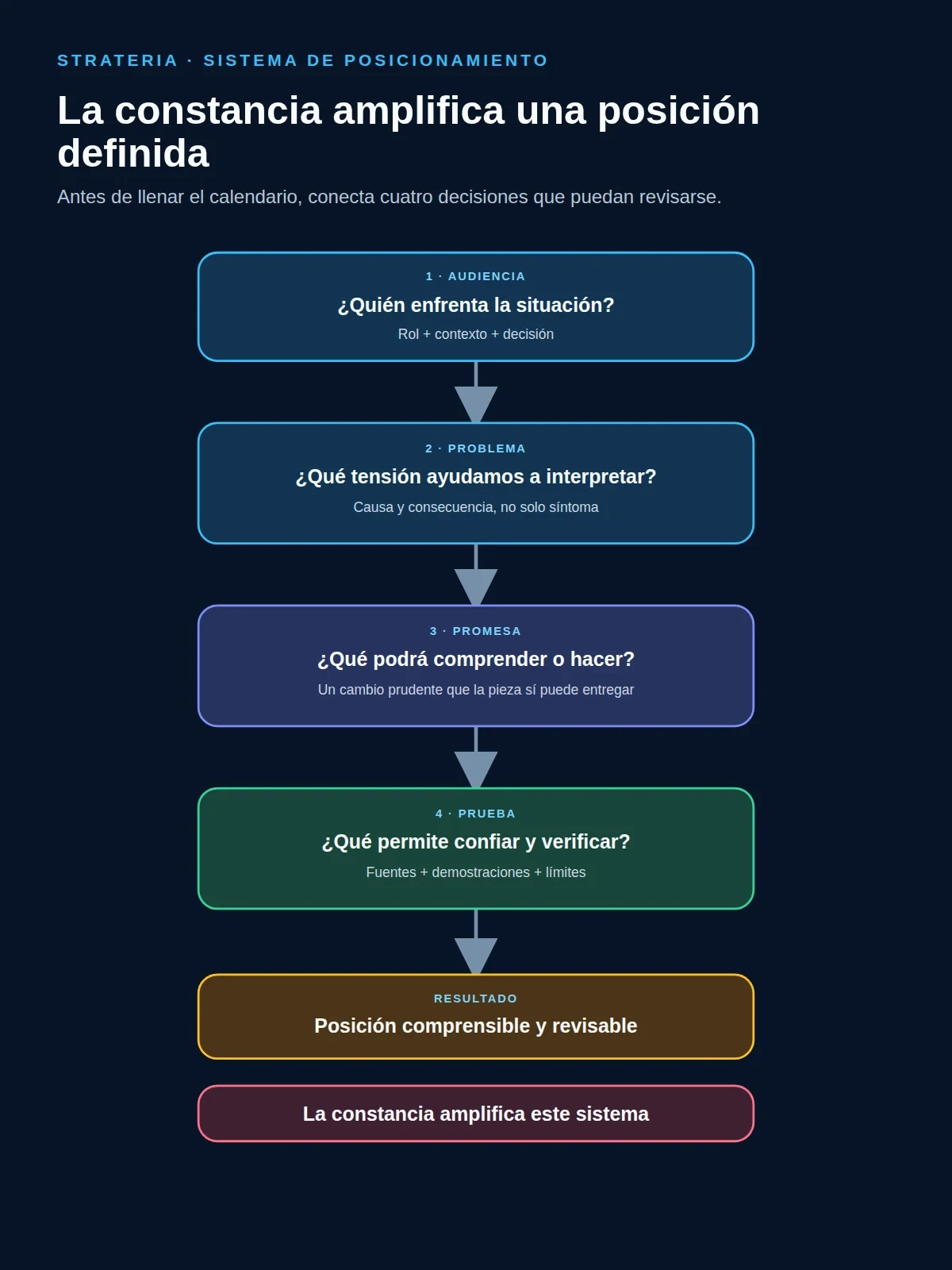
Figure 1. Constance amplifies a position when audience, problem, promise, and test form a comprehensible and verifiable system.
Source: self-published work from Keller (1993), Kapferer (2012), Google Search Central, LinkedIn Help and FTC.
Turn the four decisions into an editorial matrix
Before you plan thirty themes, create a page with four columns:
| Elements | Question to the Commission | Evidence of consistency |
|---|---|---|
| Audience | Who faces this situation and what decision they must make? | The scenes and the vocabulary correspond to that context. |
| The problem | What tension do we help interpret? | The pieces delve deeper into the causes, boundaries and alternatives of the same territory. |
| Promise | What can the reader understand or do next? | The article delivers the announced criterion without guaranteeing external results. |
| Testing | What allows you to trust and verify? | Sources, demonstrations, limits and examples are identified. |
Then submit each idea to five questions:
1. Will the priority audience recognize the situation? 2. Does the subject deepen the problem, or is it just a trend? 3. Does the promise fit inside the piece? 4. Is there evidence for important claims? 5. Is the call to action a proportionate next step?
An idea that doesn't pass through the matrix doesn't have to be discarded. It can belong to another cluster, another audience, or a later stage.
Consistency does not mean repetition
A positioning system does not require publishing the same argument.
If the territory is expert content governance, one piece can diagnose offer confusion; another, separate metrics; another, distribute responsibilities between leadership, marketing, and sales; and another, set limits for the use of AI. They change the question and the depth. They keep the priority audience, the bigger problem, the prudence of promise, and the demand for proof.
The difference between consistency and monotony is in architecture. Monotony repeats the same answer. Consistency connects different answers with a recognizable thesis.
Kapferer (2012) distinguishes the identity that an organization seeks to express from the image that ultimately forms in its audiences.
It is also worth reviewing the system with real evidence. What questions appear in comments and conversations? What terms the audience uses? What pieces attract people outside the intended audience? What promises generate misunderstandings?
A test before committing to a publishing cadence
Take the next five ideas from the calendar and hide the author's name.
- Can I identify who they were created for?
- Do I recognize a common problem?
- Do I understand what the mark is?
- Do I distinguish the proven from the recommended?
- The next step is proportional to the value delivered?
If the answers are ambiguous, increasing the frequency will only make the subsequent review more costly.
If the answers are clear, consistency already has a function: accumulating evidence around an understandable position, learning what questions matter, and improving the way to explain them.
Conclusion: First a reviewable position, then a routine
Consistency is valuable when it holds a direction. Without priority audience, defined problem, prudent promise, and verifiable proof, the calendar can produce activity without building understanding.
The minimum system doesn't need an extensive document. It needs explicit decisions that can be verified in every piece. Who is relevant to it. What problem helps to interpret. What can it honestly promise. What evidence allows for trust.
Before you ask how many times you post, ask what a person should understand after meeting you several times. That answer is the beginning of a position. Frequency comes after.
Direction first; frequency second
| Become a member of Strateria |
|---|
| If you already have ideas and consistency, but each publication seems to start from scratch, Strateria membership helps you sort through audience, problem, promise and test to sustain a recognizable professional presence without losing your judgment. |
| Register with one click: https://strateria.app/register · Free access · No card. |
References
Google Search Central. Creating helpful, reliable, people-first content. https://developers.google.com/search/docs/fundamentals/creating-helpful-content
LinkedIn Help. Content analytics for your LinkedIn Page. https://www.linkedin.com/help/linkedin/answer/a547077
Federal Trade Commission. Truth In Advertising. https://www.ftc.gov/news-events/topics/truth-advertising
Keller, K. L. (1993). Conceptualizing, Measuring, and Managing Customer-Based Brand Equity. Journal of Marketing, 57(1), 1–22. https://doi.org/10.1177/002224299305700101
Kapferer, J.-N. (2012). The New Strategic Brand Management: Advanced Insights and Strategic Thinking. 5th ed. Kogan Page. ISBN 9780749465155. https://openlibrary.org/books/OL25244022M