A good idea nobody needs is a bad business: Why is it important to understand what your market wants on LinkedIn?
Learn how to use LinkedIn to listen, compare and test what a market needs before investing in an idea that has not yet demonstrated demand.

A good idea doesn't become a business because it's original, elegant, or technically feasible. It becomes an opportunity when it solves a sufficiently important problem for a particular group that is willing to change their behavior, devote time, or pay for a solution. LinkedIn can help us understand what a professional market wants because it concentrates profiles, companies, conversations, and signals of interest. However, it's not an oracle: comments, surveys, and impressions are clues, not proven demand. The task is to combine structured listening, interviews, and small experiments.
Why can a good idea still be a bad company?
An idea describes a possible solution; an opportunity connects a problem, an audience, a value proposition, and a viable way to capture some of that value. There may be an extraordinary technology without a priority problem, or a real problem without a budget, authority, or urgency to solve it. In both cases, building first and asking later increases the cost of learning.
Kohli and Jaworski (1990) defined market orientation as generating information about current and future needs, sharing it within the organization and responding to it. Narver and Slater (1990) approached it as a culture oriented to creating superior value for the buyer. A subsequent meta-analytical review found a general positive relationship between market orientation and performance, although its magnitude depends on context and how it is measured (Kirca, Jayachandran and Bearden, 2005).
The first goal is not to prove that we're right, it's to reduce uncertainty: who's experiencing the problem, how often, what they're doing today, how much it costs them, and what would have to happen to them to consider an alternative.
What can and cannot LinkedIn reveal about your market?
LinkedIn allows you to locate professionals by job, company, sector, location and keywords. Its documentation also indicates that the results are approximate and personalized.
Posts, comments, and questions show vocabulary, disagreements, priorities, and improvised solutions. Pages offer analytics of followers, visitors, searches, and content; personal profiles have posted metrics and aggregated demographic data. These tools help detect patterns, but an impression only means that a content was shown. A like can express courtesy, affinity, or intellectual interest without intent to purchase.
LinkedIn also doesn't represent the entire population. The network, the algorithm and the way we ask a question condition what we observe. So we need to contrast platform signals with direct conversations, behavior and, where possible, real commitments.
How can you understand what your market wants on LinkedIn, step by step?
1. Turn the idea into a hypothesis
We write a statement that may turn out to be false: Talent managers in companies with 50 to 250 employees spend at least four hours a week consolidating information for X and would look for an alternative during this quarter. We'll separate five assumptions: segment, problem, frequency, consequence and willingness to act. A vague phrase like businesses need to innovate does not allow for learning.
2. Build a sample, not a crowd
We look for between 20 and 30 profiles covering users, decision makers, buyers, influencers and specialists. We vary company size, sector and experience level to avoid listening only to people like us. Gruber, MacMillan and Thompson (2013) showed that exploring a broader set of opportunities before entering the market helps to escape the corridor limited by the founder's prior knowledge.
3. Listen to the language of the problem
Let's review public posts and comments without copying databases or automating activity. Let's record phrases about frustrating tasks, desired results, current solutions, restrictions and events that trigger the need. Let's not include uncontextual mentions: an intense, recurring complaint can be more informative than twenty generic comments.
4. Doing interviews without selling
We invite you to talk with a brief and transparent message: we are investigating a problem, not yet offering a product. Let's ask for the last real episode: what happened, what the person tried, who participated, how long it took and what the consequence was. Let's avoid "would you buy my solution?" because it invites you to please and imagine. Past behavior does not predict the future perfectly, but it usually provides more concrete evidence than a hypothetical opinion.
5. Testing small messages and proposals
Let's publish two or three pieces of content that describe the problem from different angles: diagnosis, cost of not acting and current method. A survey can open a conversation, but it doesn't replace an interview or a purchase test; furthermore, LinkedIn warns you shouldn't ask for sensitive data. Then we try a more engaging action: download a guide, book a conversation, request a diagnosis or participate in a pilot.
6. Decide on defined criteria before testing
Camuffo, Cordova, Gambardella and Spina (2020) conducted a controlled trial with 116 startups and found that training entrepreneurs to formulate and test hypotheses improved the accuracy of their decisions and favored change of direction when evidence justified it.
Table 1. From a LinkedIn signal to a business decision.
| Signal observed | What it could mean | Additional evidence needed | Next action |
|---|---|---|---|
| Comments that repeat the same problem | There is shared language and possible recurrence | Recent cases, frequency and consequences | Interviewing profiles from different segments |
| High range or many reactions | The topic attracts attention | Clicks, conversations and profiles of respondents | Comparing messages and audiences |
| Requests for information | There is initial curiosity or interest | Urgency, authority and subsequent commitment | Provide diagnosis or demonstration |
| Use of spreadsheets or manual processes | There is an alternative solution. | Cost of the process and reasons for maintaining it | Proving a concrete improvement |
| Acceptance of a pilot or pre-sales | There is a willingness to assume cost or risk | Conditions, use and continuity | Running a limited test |
Source: Self-made from Kohli and Jaworski (1990), Camuffo et al. (2020) and Shepherd and Gruber (2021).
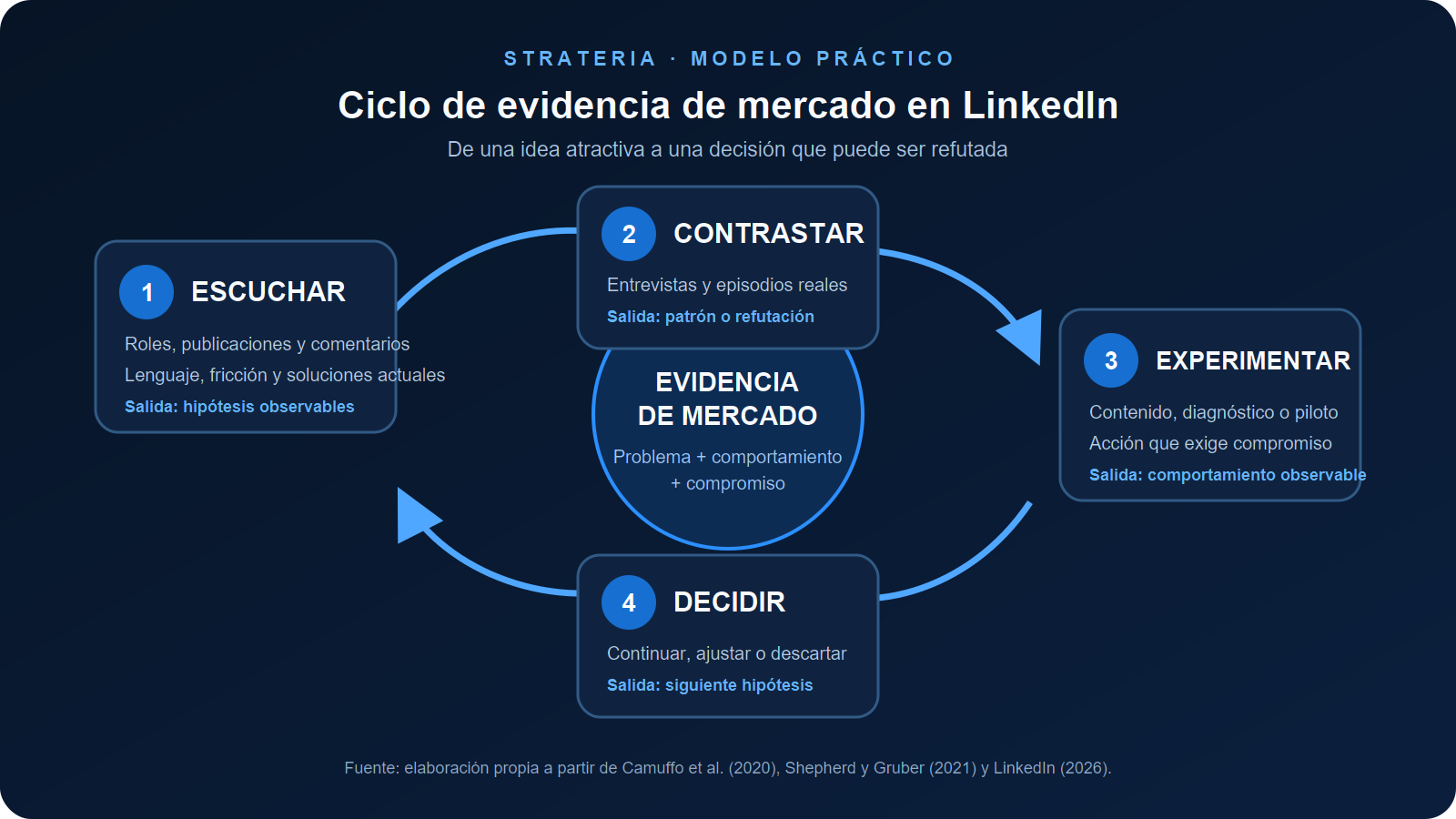
Figure 1. Cycle of evidence to move from LinkedIn conversations to a decision on opportunity.
Source: self-published work from Camuffo et al. (2020), Shepherd and Gruber (2021) and LinkedIn (2026).
Which signals carry more weight than likes?
The most useful signals combine problem and commitment. Let's look for recurrence the problem appears several times, intensity generate loss, risk or frustration and current solution the person already devotes money, time or effort to solving it. We add authority, budget and timing: whoever suffers the problem can't always buy, and a need without priority can remain years without decision.
We can sort the evidence into three levels. The weak signals include impressions, reactions and hypothetical responses. The intermediates include interviews with specific episodes, referrals to colleagues and requests for information. The strong ones require a cost: sharing non-sensitive data for a diagnosis, booking time for several people, accepting a pilot, signing a letter of intent or paying. No single signals prove a business; convergence between several reduces the risk of interpreting desire where only attention exists.
What mistakes distort research on LinkedIn?
They also distort listening only to friends, interviewing only users without talking to buyers, treating a survey as a representative sample and changing segments after each comment.
Another mistake is automating searches, profiling, or mass messaging. LinkedIn prohibits tools that scrape data or automate unauthorized activity. In addition to the risk to the account, that approach replaces understanding by volume and can deteriorate trust.
Finally, we don't confuse content with complete research. Publishing helps to attract language and participants, but the algorithm decides part of the distribution. If we want the audience to understand who's researching and why, it's best to align the proposal with the profile; you can use our guide to [optimize LinkedIn profile]https://strateria.app/en/blog/como-optimizar-perfil-linkedin).
How do you run a 30-day learning cycle?
During the first week, we define segment, five assumptions and decision criteria; in the second, we observe conversations and conduct at least five interviews with different roles; in the third, we publish two content experiments and offer a concrete, low-risk action; in the fourth, we compare what is said with the fact: repeated problems, current solutions, responses to the message and commitments made.
Shepherd and Gruber (2021) describe validated learning, customer development, minimum viable products, and the decision to persevere or change as connected components.
Conclusion: Listening before building is also strategy
A good idea that nobody needs is still a bad company because the quality of the solution doesn't automatically create priority, budget, or behavior. LinkedIn offers an accessible lab to locate professionals, learn their language, start interviews, and test messages, but its metrics don't replace market evidence.
The most prudent method starts with a false hypothesis, expands the sample beyond the nearby network, studies real episodes and ends in a test that demands some commitment. Then compares weak, intermediate and strong signals to decide without defending the idea at any cost. Listening to the market does not mean obeying each opinion; it means understanding enough patterns and restrictions to design a proposal that a particular audience can recognize, use and sustain. Sometimes the best conclusion will be to improve the idea. Other times it will be to abandon it. Both decisions can save resources and bring us closer to a better company.
References
Camuffo, A., Cordova, A., Gambardella, A., & Spina, C. (2020). A scientific approach to entrepreneurial decision making: Evidence from a randomized control trial. Management Science, 66(2), 564–586. https://doi.org/10.1287/mnsc.2018.3249
Gruber, M., MacMillan, I. C., & Thompson, J. D. (2013). Escaping the prior knowledge corridor: What shapes the number and variety of market opportunities identified before market entry of technology start-ups? Organization Science, 24(1), 280–300. https://doi.org/10.1287/orsc.1110.0721
Kirca, A. H., Jayachandran, S., & Bearden, W. O. (2005). Market orientation: A meta-analytic review and assessment of its antecedents and impact on performance. Journal of Marketing, 69(2), 24–41. https://doi.org/10.1509/jmkg.69.2.24.60761
Kohli, A. K., & Jaworski, B. J. (1990). Market orientation: The construct, research propositions, and managerial implications. Journal of Marketing, 54(2), 1–18. https://doi.org/10.1177/002224299005400201
LinkedIn. (2026). LinkedIn Page analytics. LinkedIn Help. https://www.linkedin.com/help/linkedin/answer/a547077
LinkedIn. (2026). LinkedIn Polls – FAQ. LinkedIn Help. https://www.linkedin.com/help/linkedin/answer/a527270
LinkedIn. (2026). Prohibited software and extensions. LinkedIn Help. https://www.linkedin.com/help/linkedin/answer/a1341387
LinkedIn. (2026). Search for people on LinkedIn. LinkedIn Help. https://www.linkedin.com/help/linkedin/answer/a525054
Narver, J. C., & Slater, S. F. (1990). The effect of a market orientation on business profitability. Journal of Marketing, 54(4), 20–35. https://doi.org/10.1177/002224299005400403
Shepherd, D. A., & Gruber, M. (2021). The lean startup framework: Closing the academic–practitioner divide. Entrepreneurship Theory and Practice, 45(5), 967–998. https://doi.org/10.1177/1042258719899415
From reflection to strategy
Turn this idea into action
Listening to the market allows you to improve an idea before investing too much in it. Strateria was created to help you turn that learning into clear messages, organize a consistent editorial presence, and communicate proposals that can be tested against real conversations and responses.
Create my free account Free access · No credit card