Publishing more does not clarify an offer the market does not yet understand
A practical test for connecting situation, change, boundaries and next step before multiplying messages about a professional offer.

Publishing consistently can make an experience visible and help an audience recognize a problem. It cannot, on its own, solve an offer that requires too much interpretation.
The signal appears in a common conversation. The prospective client values the ideas and recognizes the career path of the professional, but asks a basic question: What exactly would they receive? If the answer requires going through the entire work history, listing ten services or improvising a different solution for each person, more content may not be what is missing.
Understandable does not mean simple or identical for everyone. It means that a person in a particular problem can recognize what change is proposed, under what conditions, with what limits and what would be a reasonable next step.
A list of services does not equal an offer
Consulting, training, mentoring, strategy and support describes skills or formats. It does not yet explain what situation justifies hiring, what decision will help to take the service or what change the client may observe.
In B2B markets, Anderson, Narus and van Rossum distinguish the general lists of benefits of a proposal concentrated on the few elements of value that are relevant to a particular customer. The difference is decisive: the supplier thinks from within his experience; the buyer tries to understand whether the problem he faces is in the offer, how much effort will be required to move forward, and what evidence supports the promise (Anderson et al., 2006).
The Jobs to Be Done approach proposes to look at the progress a person tries to make in a specific circumstance, not just their general attributes (Christensen et al., 2016). The Value Proposition Canvas separates the client's profile jobs, difficulties, and expected results from the value map services, reliefs, and benefits to contrast their fit (Osterwalder et al., 2014).
The Four Questions of an Understandable Offer
An offer becomes easier to interpret when it connects situation, change, boundaries and the next step.
| N | What you must make clear |
|---|---|
| 1 | Situation: when it makes sense to act; moment, friction and consequence that the customer can recognize. |
| 2 | Change: what decision, ability or observable outcome helps to produce the service, without promising what it does not control. |
| 3 | Limits: what the customer receives, what is left out and under what conditions the service is provided. |
| 4 | Next step: what action is proportionate to current understanding, confidence and disposition. |
1. In what situation does it make sense?
Companies, leaders or professionals are audiences too large to guide a decision.
We help B2B teams leaves almost everything open. We help B2B firms that already produce content, but whose leaders, marketing and sales communicate different promises allows you to recognize an observable tension. It doesn't prove that the firm has the problem or that the proposal is appropriate; it creates a contrastive hypothesis.
The test is to ask whether a potential customer could say this is happening to me without adopting the supplier's jargon.
2. What concrete change does it help to produce?
The verbs transform, potentiar or optimize can express a legitimate intention, but do not allow imagining the before and the after.
A positioning consultancy does not need to promise to dominate the market. It can help define which problem to represent, whom to prioritize, what evidence supports the promise and how to distribute messages among speakers.
A professional may facilitate a diagnosis, design an architecture, train a team or accompany an implementation.
3. What does it include and what is left out?
Limits do not weaken an offer, they reduce incompatible expectations and allow for more honest comparisons of alternatives.
In services, the gaps between expectations, specifications, performance and external communication affect the perceived quality; therefore, scope is not a secondary detail (Parasuraman et al., 1985).
A clear core also does not prevent adapting the service; it allows negotiating conditions around a problem and a recognizable contribution, without turning each conversation into a different offer.
4. What is the next proportionate step?
Agenda a call requires a greater provision review this guide Request a diagnosis communicate something different from tell me your opinion. Action must correspond to the degree of understanding and confidence built.
The research on buyer uncertainty distinguishes between not knowing what information exists and not knowing which alternative to choose; both forms of uncertainty influence the search for information (Urbany et al., 1989).
A question such as 'what part of your offer should you re-explain in each conversation?' reveals more than a generic invitation to comment.
The one-sentence test
One sentence does not replace a complete business proposal. It serves as a proof of compression: if you can't yet express the center of the offer in a legible sentence, producing twenty variations of content will likely multiply the ambiguity.
Complete this structure as a draft:
We help [a person or organization in a recognizable situation] to [produce change that we can sustain] by [type of intervention], when [fit condition], and the first step is [proportional action].
Then ask her five questions:
1. Does the situation exist in words that a client would use? 2. Does the change describe a controllable contribution, not a commercial guarantee? 3. Does the intervention allow you to imagine what you receive? 4. Does the fit condition exclude cases that you cannot handle well? 5. Does the next step correspond to the current level of confidence?
It asks clients, former prospects or people who know the problem to explain in their own words what they think they would receive. The differences between their interpretations are data: they can reveal that the problem is too broad, that the result seems guaranteed or that the format dominates the value.
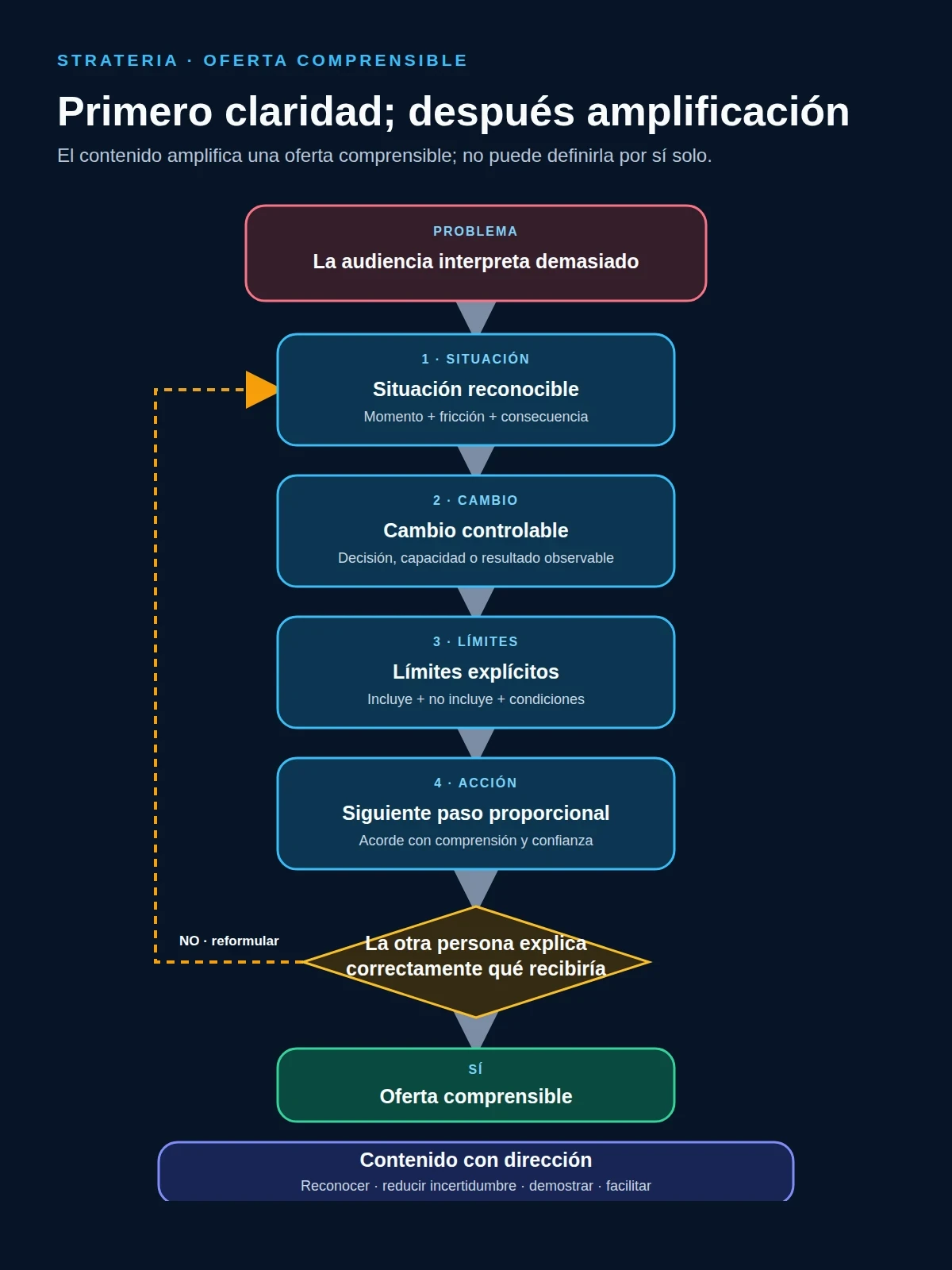
First it is contrasted if another person understands what they would receive. Only then can the content amplify the offer with direction. The test confirms understanding, not demand.
What role does content play after clarifying the offer?
A clear offer does not eliminate the need for content; it changes its function. A piece can help recognize a situation, explain why it occurs, show criteria to compare alternatives, declare limits, answer objections or facilitate an action.
When the offer is unclear, the calendar becomes a laboratory without hypotheses: one day it speaks to beginners, the next to managers; one publication offers training and another suggests a different consultancy.
Strateria can help organize audiences, ideas, drafts, timing and content review. It does not replace market research or decide what promise a professional can hold. Automation can bring consistency; defining the offer requires conversations, evidence, operational limits and human approval.
Conclusion: before you multiply messages, reduce room for interpretation
Sometimes the audience receives many expressions of experience and no stable answer to four questions: Is this for a situation like mine? What change does it help produce? What does it include and what does not? How can I move forward?
Before writing the next piece, formulate the offer in a sentence and check how someone else interprets it.
First clarity, then amplification
| Become a member of Strateria |
|---|
| If your offer still demands too much explanation, Strateria membership helps you sort out situation, change, boundaries and next step so that the content amplifies a clear proposal rather than multiplying interpretations. |
| Register with one click: https://strateria.app/register · Free access · No card. |
References
Anderson, J. C., Narus, J. A. y van Rossum, W. (2006). Customer Value Propositions in Business Markets. Harvard Business Review. https://hbr.org/2006/03/customer-value-propositions-in-business-markets
Blank, S. (2013). Why the Lean Start-Up Changes Everything. Harvard Business Review. https://hbr.org/2013/05/why-the-lean-start-up-changes-everything
Christensen, C. M., Hall, T., Dillon, K. y Duncan, D. S. (2016). Know Your Customers’ “Jobs to Be Done”. Harvard Business Review. https://hbr.org/2016/09/know-your-customers-jobs-to-be-done
Kohli, A. K. y Jaworski, B. J. (1990). Market Orientation: The Construct, Research Propositions, and Managerial Implications. Journal of Marketing, 54(2), 1–18. https://doi.org/10.1177/002224299005400201
Osterwalder, A., Pigneur, Y., Bernarda, G. y Smith, A. (2014). Value Proposition Design: How to Create Products and Services Customers Want. John Wiley & Sons. https://www.wiley.com/en-us/Value+Proposition+Design%3A+How+to+Create+Products+and+Services+Customers+Want-p-9781118968055
Parasuraman, A., Zeithaml, V. A. y Berry, L. L. (1985). A Conceptual Model of Service Quality and Its Implications for Future Research. Journal of Marketing, 49(4), 41–50. https://doi.org/10.1177/002224298504900403
Urbany, J. E., Dickson, P. R. y Wilkie, W. L. (1989). Buyer Uncertainty and Information Search. Journal of Consumer Research, 16(2), 208–215. https://doi.org/10.1086/209209