Right content, wrong audience: where expert positioning goes off course
A guide to reviewing problem, level, context and next step before interpreting engagement as demand.

A publication can be well written, hold a certain idea, and receive favorable comments, but still attract people who will hardly recognize, prioritize, or be able to solve the problem you're talking about with you.
The first criterion asks if the piece is clear, useful and defensible. The second asks for who it is, in what situation and with what possible continuity. When both are confused, the interaction seems to validate the positioning although perhaps only validate that the topic is interesting to a broad group.
This does not make those readers into a mala audience. Colleagues, students, curious and professionals from other sectors can contribute valuable conversations.
The wrong audience is not defined by position or size.
A relevant audience is not simply a list of positions, industries or ages. Two people in the same position may face very different decisions. One may be exploring a topic; another must resolve it this quarter; a third lacks authority, resources or context to act.
This is why it is appropriate to define the public from a recognizable situation: what it is trying to achieve, what stresses it faces, what alternatives it evaluates and what costs it would have if it did not decide.
Christensen, Hall, Dillon and Duncan (2016) propose to understand the choice from the work that a person tries to make in a particular circumstance. This perspective does not replace segmentation, but avoids confusing attributes of the public with the progress they seek. Wedel and Kamakura (2000) recall, from market research, that segmentation involves identifying relevant groups for a differentiated response, not just accumulating descriptive variables.
Google recommends assessing whether a site has an existing or planned audience that would find content useful if it reached it directly, and also whether the content demonstrates a primary purpose. Although that guidance belongs to Search, the editorial criterion is broader: know for whom a piece is produced and what it allows you to do avoid writing solely to capture available attention.
LinkedIn, in its guidance on thought leadership, also insists on knowing the target audience and offering relevant and useful perspectives. Relevance does not require each reader to guess. It requires making an explicit decision about the situation the piece intends to serve.
That decision requires continuous learning. Kohli and Jaworski (1990) describe market orientation as the generation of intelligence about present and future needs, its circulation within the organization and a coordinated response. For an editorial strategy, the consequence is clear: the audience is formulated as a hypothesis and corrected with evidence, not as a permanent label agreed upon within the team.
Deviation 1: the subject is broad, but the problem remains invisible
Leadership, innovation, artificial intelligence, productivity or personal branding can bring many people together.
A consultant that publishes about leadership can attract students, leaders in training, new bosses and executives in large companies. That breadth is not a defect. It becomes a friction when its offer, for example, is designed for founding teams that must distribute decisions after they grow up. If you never name that scene, the right audience does not receive enough signal to distinguish the overall content of an applied ability.
The correction is to get off the ground at the time of decision. Instead of five ideas about leadership, the piece can start with a tension: the founder wants to delegate, but every important decision still goes back to his desk. The second wording does not exclude people arbitrarily; it allows certain people to recognize themselves more accurately.
A control question helps: can the reader describe the situation to which the content refers without repeating an abstract category?
Deviation 2: the level of the explanation does not match the level of the decision
The same subject supports introductory, technical, executive or comparative explanations. Each attracts a different intention. A basic tutorial can be excellent for the learner, but insufficient for the one who must assess risks, responsibilities and implementation costs. A sophisticated analysis can impress specialists and prove unusable for a buyer who needs to decide where to start.
This deviation often occurs when the creator writes to demonstrate mastery before peers. The vocabulary, references and exceptions show depth, but the client's decision falls out of the picture. It also occurs in the opposite sense: it is simplified so much to maximize reach that the criterion by which an expert could be chosen disappears.
Aligning the level doesn't mean making the content superficial. It means choosing what depth that decision needs. A person who evaluates incorporating AI into a process doesn't need, in the first piece, a full explanation of the foundational models.
The proof here is straightforward: does the complexity of the explanation reduce the uncertainty of the intended audience or just show how much the author knows?
Deviation 3: the situation is interesting but not relevant to the context of the offer
An idea may be relevant in theory and not fit into the kind of context that the professional can serve. They change the size of the organization, regulation, stage of business, budget, degree of autonomy or urgency. Ignoring those conditions attracts conversations that seem close but have no operational fit.
Let's say a firm works with B2B companies that already have a sales team and need to coordinate messages between leadership, marketing and sales. If their content talks about getting the first customers without clarifying context, it can mainly attract entrepreneurs who are still validating their offer.
It is not necessary to turn each publication into a requirement sheet. All you have to do is input context signals: when the sales team already hears repeated objections, in a firm where several people represent the brand or before automating an approval that today depends on informal criteria. These phrases help the right reader to position themselves and allow others to understand the limits.
Boundaries also build confidence. Deciding what situation a method does not serve avoids attracting expectations that will then need to be corrected in a call. Specificity reduces potential volume, but improves the interpretation of the received signals.
Deviation 4: the piece attracts interest, but the next step selects another intention
The call to action also defines the audience. ‘Share your opinion’ invites open conversation. ‘Download an introductory guide’ attracts people who want to learn. ‘Describe the process you need to coordinate’ asks for context. ‘Book a demonstration’ assumes more advanced intent. No action is universally superior; each selects a different disposition.
A piece can talk to a manager with a specific problem and end up with a generic action that dilutes that relevance. It can also ask for a meeting too early and lose the person who is barely evaluating the matter.
For the purpose of this article, the proper continuity is not to promise an automatic diagnosis. It is to invite us to review the connection between experience, problem, offer and progress. https://strateria.app/en/blog/experiencia-demanda-cuatro-fricciones.
The call to action works as a final filter. If we want to learn if an audience recognizes a problem, we should ask for a situation-revealing answer, not just an agreement. A question like "At what point in the process is consistency lost?" produces different information than "What do you think?"
Four filters before interpreting the metrics
Before concluding that a piece has reached the right audience, it is worth going through four editorial filters: problem, level, context and progress.
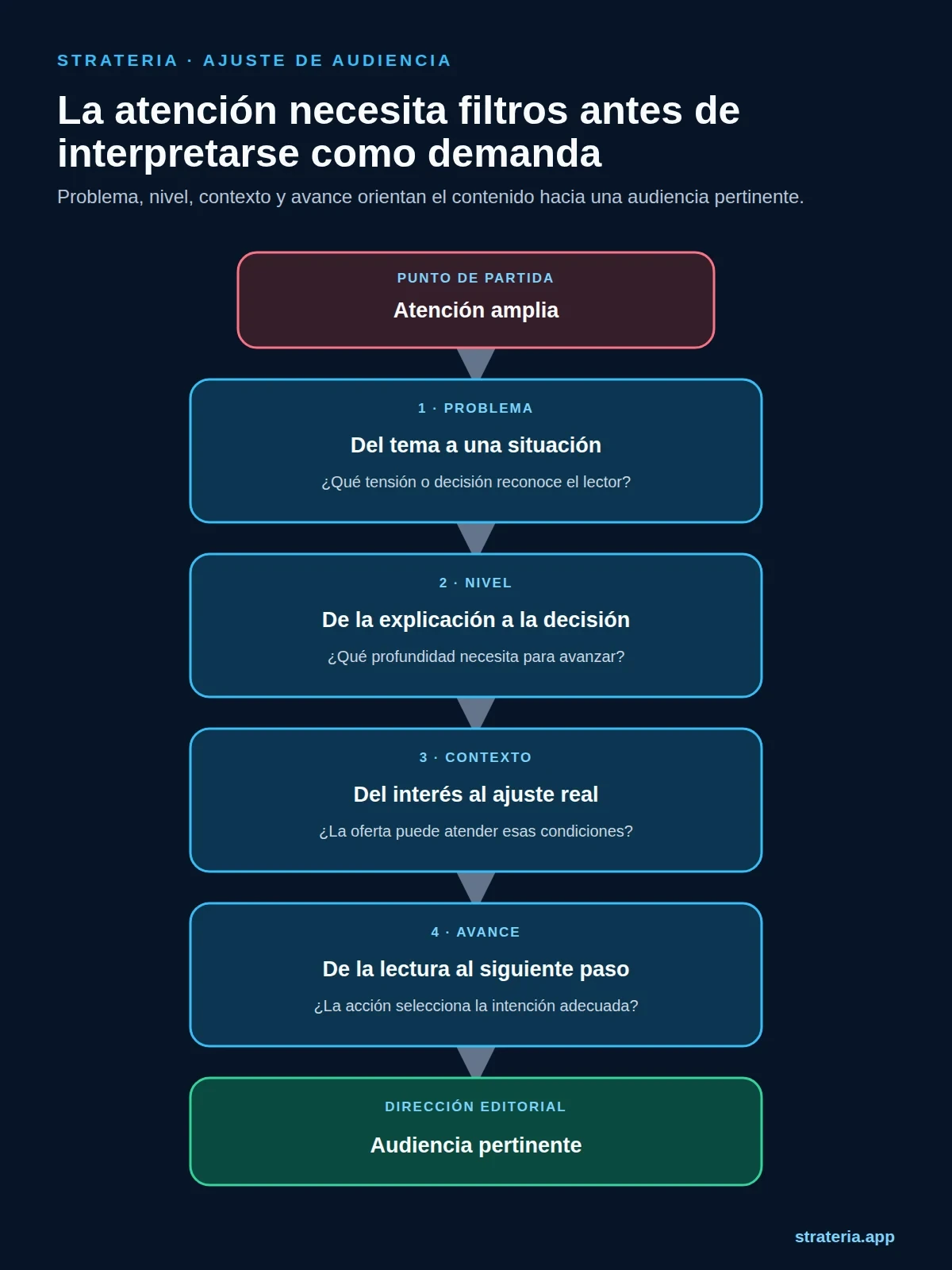
Figure 1. Four filters to check the fit between content and audience.
Source: self-made.
Table 1. Test of the fit between content and audience.
| Filter | Signal and review question |
|---|---|
| The problem | Signal: the reader recognizes a subject, but not a situation. |
| Level | Signal: The explanation is impressive, but it doesn't reduce uncertainty. |
| Context of the text | Question: What are the conditions under which our criterion becomes applicable? |
| Go ahead . | Signal: the action asks for a different intention from the one that built the content. |
The table itself does not prove that there is a market, nor does it allow a record or query to be attributed to a specific phrase, but it serves to formulate a more precise editorial hypothesis before looking at reach, comments, clicks or conversions.
A useful metric needs a preliminary question
The metrics are not irrelevant; they are ambiguous without a hypothesis. Many impressions can indicate good distribution. Saved ones can suggest future utility. Comments can reveal resonance or disagreement. Clicks show a transition. None of these signals identify by themselves whether the person corresponds to the intended audience.
Interpretation improves when each piece declares what it's trying to learn. For example: We want to know if those responsible for B2B firms recognize the fragmentation between what they promise leadership, marketing, and sales. Then comments, queries, and questions can be classified according to the context they reveal, without inventing causality.
If a reader says that the problem only appears in much larger organizations, he provides information about the framework. If basic questions arise when the piece was intended to support an advanced decision, perhaps the level or distribution needs to be adjusted. Learning does not just involve counting favorable answers.
How to write for a specific audience without narrowing the message too much
Specificity does not require repeating the name of the ideal customer in each paragraph. It can be built through scenes, decisions, restrictions and consequences. These signals allow the content to remain readable to other audiences without losing its center.
A practical sequence before writing is to complete four sentences:
This piece is for someone who's trying to... You'll recognize the problem when you look... You need to distinguish between... After reading, the proportional step is...
Then it checks whether the draft actually contains those answers. If the audience only appears in the brief, but not in the text, the fit is still an internal intention. If the call to action does not correspond to the promised learning, the chain breaks down at the end.
The goal is not to prevent other people from reading or sharing, but to prevent the brand from losing the recipient while trying to please everyone.
What role does Strateria play?
Strateria helps to organize editorial decisions such as audience, problem, thesis, evidence, relationship to the offer and call to action.
The tool does not automatically identify the right customer or guarantee demand. The definition of audience requires research, conversations and business learning. The value of the system is in making the hypotheses explicit and reducing the dispersion between idea, content and the next step.
Conclusion: Quality also needs direction
Right content can attract the wrong audience because accuracy and relevance are not the same. The first protects the integrity of the piece. The second connects that piece with a situation, a level of decision, a context and a way forward.
Before you interpret interaction as demand, review the four filters. Name the problem beyond the subject, adjust the depth of the decision, state the conditions that make your judgment applicable, and propose proportional action. It doesn't guarantee opportunities, but it makes it clearer which audience you're trying to help and which signals are worth learning.
From quality to relevance
| Become a member of Strateria |
|---|
| If the content receives attention, but not from the people for whom the offer may be relevant, Strateria membership helps you sort audience, problem, depth and next step before expanding production. |
| Register with one click: https://strateria.app/register · Free access · No card. |
References
Christensen, C. M., Hall, T., Dillon, K., y Duncan, D. S. (2016). Know your customers’ “jobs to be done”. Harvard Business Review. https://hbr.org/2016/09/know-your-customers-jobs-to-be-done
Google Search Central. (2026). Creating helpful, reliable, people-first content. https://developers.google.com/search/docs/fundamentals/creating-helpful-content
Kohli, A. K., y Jaworski, B. J. (1990). Market orientation: the construct, research propositions, and managerial implications. Journal of Marketing, 54(2), 1–18. https://doi.org/10.1177/002224299005400201
LinkedIn. (2026). What is thought leadership? https://business.linkedin.com/advertise/resources/marketing-terms/thought-leadership
Wedel, M., y Kamakura, W. A. (2000). Market segmentation: conceptual and methodological foundations (2nd ed.). Springer. https://doi.org/10.1007/978-1-4615-4651-1
Para profundizar en la conexión entre experiencia y demanda, revisa https://strateria.app/en/blog/experiencia-demanda-cuatro-fricciones.