Differences between personal brand and professional brand and how to build them on LinkedIn
Understand what distinguishes personal brand from professional brand and apply an evidence-based method to integrate both with clarity and credibility on LinkedIn.
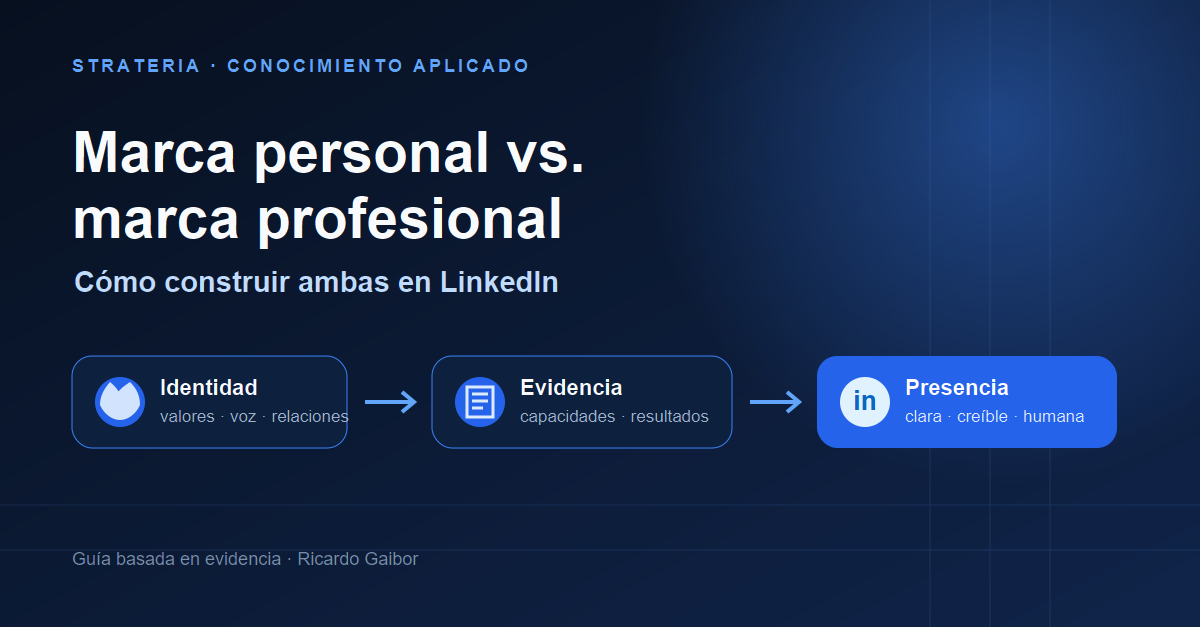
Personal brand and professional brand are not two separate characters. The first expresses the broader combination of values, traits, interests, voice, and relationships for which a person wants to be recognized; the second focuses that identity in a work context and answers what they know how to do, for whom, with what standards, and with what evidence. On LinkedIn we need both: humanity to be remembered and professional clarity to be understood and considered. Building them is not about fabricating an image or posting every day, but about aligning identity, value proposition, evidence, and behavior. This guide explains the differences, shows how to integrate them, and proposes a method to turn profile and activity into a credible presence.
What is a personal brand?
Personal brand is the strategic process of creating, positioning, and maintaining a desired impression based on a differentiated combination of individual characteristics. The systematic review by Gorbatov, Khapova, and Lysova (2018), based on 100 works, highlights that it includes intention, audience, narrative, and image, but also the actual response of other people. That is why it is not equivalent to a logo, a color palette, or a catchy phrase.
Its raw material includes values, motivations, communication style, interests, experiences, and way of relating. It can manifest inside and outside work. A person may be recognized for explaining complex matters simply, fostering respectful conversations, and connecting science with action; these signals go beyond a specific role and can accompany them through different transitions.
Labrecque, Markos, and Milne (2011) observed that digital presence also creates challenges: information published by oneself coexists with comments, photos, and references created by third parties. Therefore, personal brand is not completely controlled. It is guided through consistency, conduct, and periodic review.
What do we mean by professional brand?
Professional brand is the work expression of a person's identity: the perception of their competencies, contribution, judgment, experience, and trustworthiness in a field. It is a practical, useful category, although academic literature more often uses concepts such as professional identity, reputation, and self-presentation. It should not be presented as a universal scientific definition.
Professional identity develops through learning, practice, relationships, professional norms, and reflection. Trede, Macklin, and Bridges (2012) note, in a review of 20 studies, that tensions between personal and professional values, discipline, context, and workplace learning are involved. Pratt, Rockmann, and Kaufmann (2006) showed, in medical residents, that identity adapts through cycles of work and learning; it is not born finished when writing a profile.
In practical terms, a professional brand answers four questions: what problems can we address? what capabilities do we apply? what evidence supports that claim? and what can others expect when working with us? A job title describes a position; a professional brand communicates a transferable contribution.
What are the differences between personal brand and professional brand?
The main difference is scope. Personal brand encompasses attributes that can accompany us across different domains; professional brand selects and organizes those relevant to a work audience. Both influence each other: values guide how we work and experience changes how we understand ourselves.
Table 1. Practical differences between personal brand and professional brand.
| Dimension | Personal brand | Professional brand | LinkedIn application |
|---|---|---|---|
| Central question | Why do I want to be remembered? | For what contribution do I want to be chosen or consulted? | Combine purpose and expertise in a clear proposition |
| Scope | Values, voice, interests, experiences, and relationships | Competencies, results, judgment, and work standards | Show personality without displacing evidence |
| Audiences | Broad community and diverse relationships | Clients, employers, colleagues, allies, or sector | Prioritize one or two professional audiences |
| Evidence | Consistency between message and behavior | Projects, results, experience, and third-party validation | Experience, projects, publications, and recommendations |
| Risk | Excessive exposure or artificial persona | Generic profile, jargon, or history without a proposition | Review privacy, relevance, and consistency |
Source: own elaboration based on Gorbatov et al. (2018), Trede et al. (2012), and van Dijck (2013).
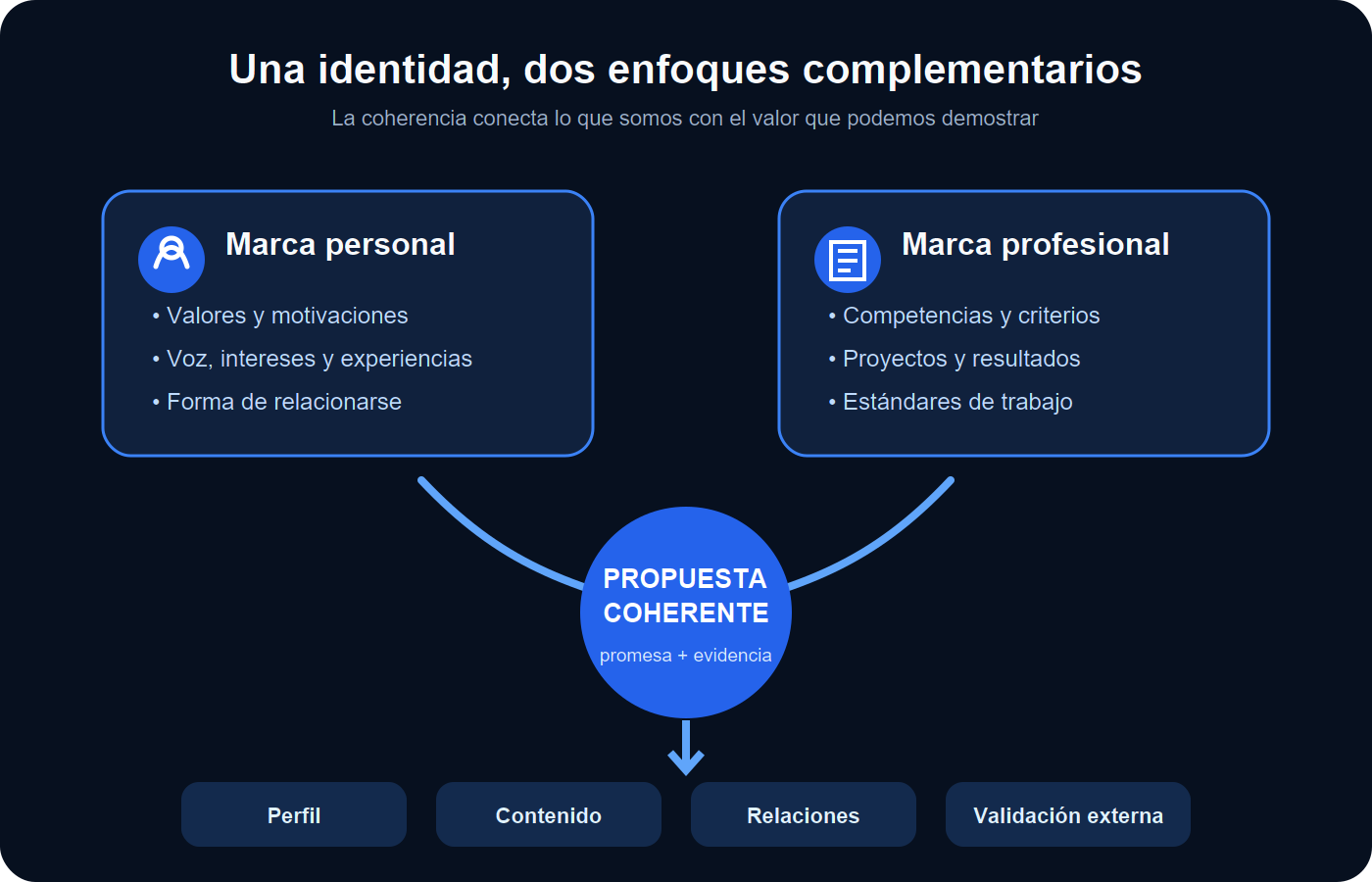
Figure 1. Credible presence emerges by connecting personal identity, professional evidence, and consistent signals on LinkedIn.
Source: own elaboration based on Gorbatov et al. (2018), Ibarra (1999), and LinkedIn (2026).
How to build both brands on LinkedIn step by step?
1. Define objective and audience
Before editing the profile, let's choose the outcome LinkedIn should facilitate over the next six months: finding a job, attracting clients, consolidating authority, expanding a sector network, or preparing a transition. Then define who we need to be useful to. 'Everyone' is not an operational audience.
2. Separate identity from evidence
Let's prepare two inventories. In the personal one, note values, topics, relational strengths, formative experiences, and communication style. In the professional one, record problems solved, capabilities, projects, verifiable results, knowledge, and recognitions. Not everything must be published; the exercise allows us to choose what is relevant without inventing a personality.
Ibarra (1999) found that during professional transitions, people test provisional identities by observing role models, experimenting, and evaluating responses. This supports a gradual practice: rehearsing a new narrative through projects and conversations before declaring ourselves experts in a new field.
3. Formulate a bridge proposition
Complete this sentence: 'I help [audience] achieve [outcome or problem] through [capabilities or approach], with [evidence or differentiating criterion].' Then check each element. If there is not yet enough evidence, turn the aspiration into a learning or project plan, not an inflated claim.
4. Translate the proposition into the profile
The headline should make the field and contribution understandable; the About section can explain motivation, expertise, evidence, and next step. Experience needs contextualized actions and results. Projects, publications, certifications, skills, and recommendations add proof when relevant. LinkedIn (2026) describes the profile as a professional page for managing personal brand and recommends keeping headline, summary, experience, and education aligned.
To review each section in more detail, you can use our guide on how to optimize your LinkedIn profile: https://strateria.app/en/blog/como-optimizar-perfil-linkedin. The rule is simple: a promise should lead to visible evidence.
5. Publish three types of signals
A balanced presence can alternate evidence, interpretation, and professional humanity. Evidence shows verifiable projects, decisions, and learnings. Interpretation explains sector trends or problems with your own judgment. Professional humanity reveals values through relevant stories, recognition of others, and reflection, without turning intimacy into a visibility requirement.
Van Dijck (2013) warns that platforms condition the way we present ourselves through their interfaces. Therefore, we should not confuse what LinkedIn temporarily rewards with our identity. Content needs to serve the audience and sustain the proposition, even if the preferred format changes.
6. Build relationships and external validation
The brand is not consolidated only by talking about oneself. Let's comment with concrete contributions, converse with colleagues, acknowledge sources, and request recommendations from people who have observed our work. Chiang and Suen (2015) found that the quality of self-presentation arguments in LinkedIn profiles influenced perceptions of professional and organizational fit linked to hiring recommendations.
This does not make a profile a complete evaluation. Roulin and Levashina (2019) showed that structured assessments from LinkedIn can offer information about certain competencies, but also raise limitations of reliability, validity, and fairness. Prudence requires showing specific evidence and avoiding exaggerated inferences about other people.
What mistakes weaken both brands?
The first mistake is creating a persona that cannot be sustained off-screen. Copying trendy phrases, declaring yourself a reference without proof, mixing too many specialties, posting personal issues without privacy criteria, and turning every interaction into a sale also hurt. At the opposite extreme, a profile composed only of titles and tasks may be correct but hard to remember.
Another mistake is confusing consistency with repetition. Consistency maintains values, field, and quality; it allows varying formats and evolving. A legitimate professional change does not destroy personal brand if we explain what we learned, what remains, and what new contribution we are building.
How to evaluate whether the presence is working?
Each month, review three levels. For clarity, ask five people what they understand we do and for whom. For credibility, check whether the central claims lead to projects, results, or validation. For relationship, observe whether relevant conversations, invitations, inquiries, or collaborations appear, not just impressions.
LinkedIn metrics help detect changes, but they do not by themselves demonstrate reputation or quality. If reach increases but conversations remain irrelevant, we should review audience and topics. If the profile receives visits but no inquiries, perhaps clarity, evidence, or a concrete invitation is missing. For a broader architecture, you can consult the six elements of a solid personal brand on LinkedIn: https://strateria.app/en/blog/elementos-marca-personal-linkedin.
Conclusion: one identity, two complementary approaches
Personal brand answers how we want to be recognized as people; professional brand concentrates that answer into the value we can contribute in a work context. Separating them completely produces incoherence. Confusing them leaves a human but imprecise presence, or a competent but interchangeable profile.
The strongest path begins with identity and objective, continues with an evidence inventory, and translates into an understandable proposition. Then we align profile, content, relationships, and external validation. LinkedIn is where these signals become visible, not the source of our identity or a guarantee of opportunities. When what we say, show, and do reasonably coincides, the brand stops being self-promotion and becomes a professional reputation that others can understand, verify, and remember.
References
Chiang, J. K.-H., & Suen, H.-Y. (2015). Self-presentation and hiring recommendations in online communities: Lessons from LinkedIn. Computers in Human Behavior, 48, 516–524. https://doi.org/10.1016/j.chb.2015.02.017
Gorbatov, S., Khapova, S. N., & Lysova, E. I. (2018). Personal branding: Interdisciplinary systematic review and research agenda. Frontiers in Psychology, 9, 2238. https://pmc.ncbi.nlm.nih.gov/articles/PMC6258780/
Ibarra, H. (1999). Provisional selves: Experimenting with image and identity in professional adaptation. Administrative Science Quarterly, 44(4), 764–791. https://doi.org/10.2307/2667055
Labrecque, L. I., Markos, E., & Milne, G. R. (2011). Online personal branding: Processes, challenges, and implications. Journal of Interactive Marketing, 25(1), 37–50. https://doi.org/10.1016/j.intmar.2010.09.002
LinkedIn. (2026). Add sections to your profile. LinkedIn Help. https://www.linkedin.com/help/linkedin/answer/a540837
LinkedIn. (2026). Create a good LinkedIn profile. LinkedIn Help. https://www.linkedin.com/help/linkedin/answer/a554351
Pratt, M. G., Rockmann, K. W., & Kaufmann, J. B. (2006). Constructing professional identity: The role of work and identity learning cycles in the customization of identity among medical residents. Academy of Management Journal, 49(2), 235–262. https://doi.org/10.5465/amj.2006.20786060
Roulin, N., & Levashina, J. (2019). LinkedIn as a new selection method: Psychometric properties and assessment approach. Personnel Psychology, 72(2), 187–211. https://doi.org/10.1111/peps.12296
Trede, F., Macklin, R., & Bridges, D. (2012). Professional identity development: A review of the higher education literature. Studies in Higher Education, 37(3), 365–384. https://doi.org/10.1080/03075079.2010.521237
van Dijck, J. (2013). “You have one identity”: Performing the self on Facebook and LinkedIn. Media, Culture & Society, 35(2), 199–215. https://doi.org/10.1177/0163443712468605
From reflection to strategy
Turn this idea into action
When identity, experience, and evidence tell the same story, professional communication stops feeling like a performance. Strateria was created to help you find that connecting thread and turn it into a content strategy that preserves your voice while clearly communicating the value you can contribute.
Create my free account Free access · No credit card